
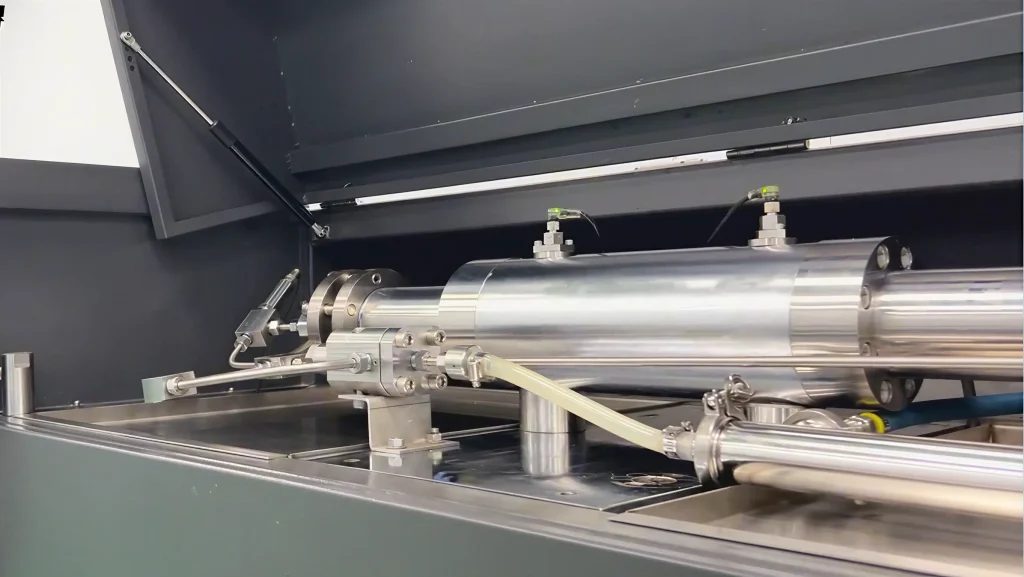
Modern scientific research and industrial manufacturing increasingly demand materials with superior uniformity, stability, and nanoscale particle size. Whether developing advanced battery materials, producing lipid nanoparticles for pharmaceuticals, engineering graphene dispersions, or creating high-performance emulsions, conventional mixing technologies often struggle to deliver consistent results.
This is where the microfluidics homogenizer has become an indispensable processing solution. By combining microfluidic technology with ultra-high pressure processing, this advanced high pressure homogenizer enables precise particle size reduction, highly uniform dispersion, efficient cell disruption, and exceptional emulsion stability.
Unlike traditional rotor-stator mixers or colloid mills, microfluidic homogenization relies on controlled fluid dynamics within specially engineered microchannels, generating intense shear forces, cavitation, turbulence, and particle collisions that produce repeatable nanoscale processing.
This article explains how microfluidics homogenizers work, their key advantages, major applications, and why they have become essential equipment for laboratories and industrial production worldwide.
Why Material Homogenization Is Critical for Modern Manufacturing
Material homogenization is a fundamental process in modern manufacturing that directly influences product quality, process efficiency, and production consistency. Whether producing dairy products, pharmaceuticals, cosmetics, or advanced chemical materials, achieving a uniform particle size and stable distribution is essential for ensuring reliable performance and meeting strict quality standards. Effective homogenization improves texture, enhances product stability, increases the bioavailability of active ingredients, and reduces the risk of phase separation or sedimentation. As manufacturers continue to demand higher precision, greater efficiency, and more sustainable production methods, advanced solutions such as a microfluidizer homogenizer and high pressure homogenizer have become indispensable. By utilizing microfluidic technology, these systems enable finer particle size reduction, narrower particle size distribution, and highly repeatable processing, helping manufacturers deliver superior products while optimizing productivity and reducing operational costs.
How the JUNJIE Microfluidics Homogenizer Works
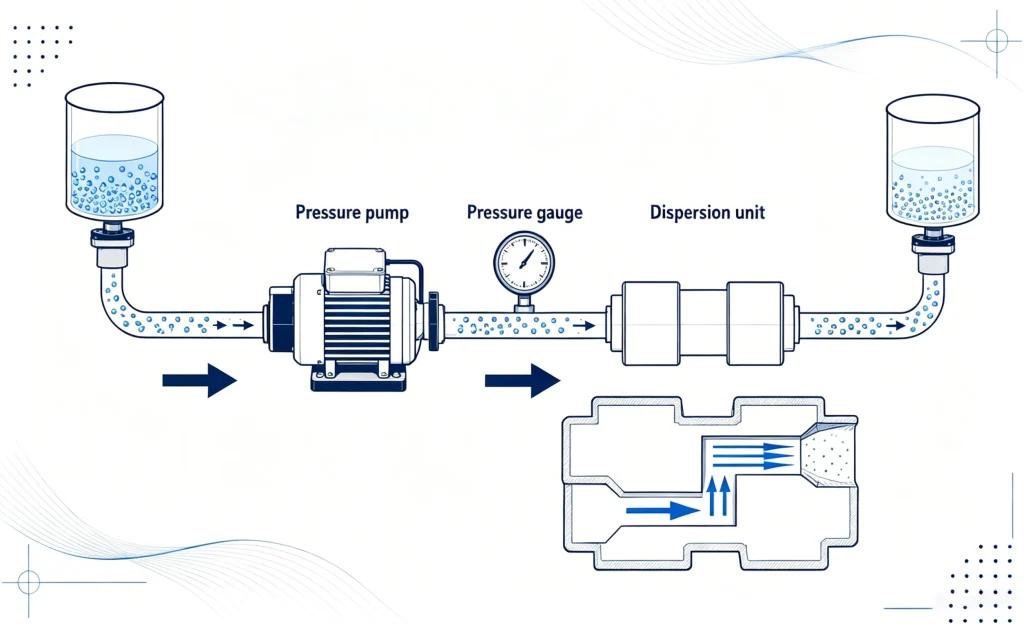
The JUNJIE microfluidizer utilizes ultra-high pressure microjet technology. Its working principle can be summarized as follows:
Core Working Principle
- Ultra-high pressure pressurization: The material is pressurized to an ultra-high pressure of up to 420 MPa (approximately 60,900 psi) by a booster pump.
- Micron-channel acceleration: The high-pressure material passes through a specially designed micron-sized channel (diamond interaction chamber or homogenizing valve) and is accelerated to an extremely high velocity.
- High-speed collision with triple action: The material is split into multiple streams inside the channel, where they collide with each other at high speed at precisely designed impact points or shear zones, generating three synergistic forces:
- High shear force: Strong shear generated as the material passes through the micro-channel at high speed
- Cavitation effect: Cavitation bubble formation and collapse caused by rapid pressure changes
- High-frequency oscillation: High-speed collision and oscillation of the material within the channel
- Nanoscale homogenization achieved: Under the synergistic effect of the three forces above, material particles are broken down to the nanoscale, achieving homogenization from micron to nanometer level.
Technical Features
| Feature | Description |
|---|---|
| Fixed-geometry channel design | Uses “Y” or “Z” type flow paths in diamond interaction chambers, with no dead zones — all material receives the same energy treatment |
| No grinding media | Pure physical processing, no grinding media, eliminating metal contamination at the source |
| Adjustable pressure | Supports 0-420 MPa stepless adjustment, adaptable to different material properties |
| Extremely narrow particle size distribution | High uniformity and batch-to-batch consistency |
Two Core Processing Unit Options
| Option | Material | Application |
|---|---|---|
| Diamond Interaction Chamber | Full diamond | Ultra-high purity requirements (pharmaceuticals, semiconductors, CMP slurries, etc.) |
| Homogenizing Valve | Cemented carbide / ceramic | Standard purity requirements, high-viscosity materials (food, che |
Advantages of Ultra-High Pressure Homogenization Technology
1. Nanometer Particle Size Reduction
One of the greatest advantages is producing particles in the 50–200 nm range, with some applications achieving even smaller sizes.
Benefits include:
- Increased surface area
- Improved dissolution
- Enhanced bioavailability
- Better suspension stability
2. Excellent Dispersion Performance
Agglomerated particles are effectively separated and evenly distributed throughout the medium.
Typical materials include:
- Graphene
- Carbon nanotubes
- Ceramic nanoparticles
- Silicon materials
- Metal oxides
- Pigments
3. Superior Emulsion Stability
Nanoemulsions exhibit:
- Reduced droplet size
- Improved storage stability
- Enhanced appearance
- Better product consistency
Applications include:
- Cosmetics
- Functional beverages
- Pharmaceuticals
- Food ingredients
4. Efficient Cell Disruption
Microfluidics homogenizers are widely used for:
- Bacteria
- Yeast
- Algae
- Mammalian cells
Efficient cell lysis improves extraction of:
- Proteins
- Enzymes
- DNA
- RNA
- Intracellular metabolites
5. Easy Scale-Up
One major advantage of microfluidic technology is process scalability.
Researchers can optimize formulations using laboratory equipment before transferring identical processing conditions to pilot and industrial systems, minimizing redevelopment time.
Industrial Applications of Microfluidizer Homogenizers
Pharmaceutical & Biotechnology
The pharmaceutical industry depends heavily on high pressure homogenizer systems for:
- Liposome production
- Lipid nanoparticles (LNP)
- Vaccine formulation
- Drug delivery systems
- Cell disruption
- Protein extraction
Uniform particle size directly affects drug efficacy and stability.
New Energy Materials
Battery manufacturers increasingly use microfluidics homogenizers to disperse:
- Lithium battery slurry
- Silicon anode materials
- Conductive carbon black
- Graphene
- Carbon nanotubes
Uniform dispersion improves battery consistency and electrochemical performance.
Advanced Nanomaterials
Applications include:
- Graphene dispersion
- Carbon nanotubes
- Ceramic nanoparticles
- Metal nanopowders
- Quantum dots
- Functional coatings
Food & Beverage
The food industry uses high pressure homogenizers to produce:
- Dairy products
- Plant-based beverages
- Nutritional drinks
- Sauces
- Flavor emulsions
Benefits include improved texture, stability, and shelf life.
Cosmetics & Personal Care
Microfluidic processing creates highly stable formulations for:
- Creams
- Lotions
- Nanoemulsions
- Active ingredient delivery
- Skincare serums
Smaller droplets improve sensory performance and ingredient penetration.
Chemical Industry
Industrial chemical applications include:
- Pigments
- Coatings
- Adhesives
- Catalysts
- Specialty chemicals
Features That Improve Productivity and Process Reliability
Beyond its advanced homogenization performance, the JUNJIE Microfluidizer Homogenizer is engineered to maximize productivity and ensure consistent process reliability. Its precision control system maintains stable pressure and repeatable operating conditions, delivering uniform results from laboratory-scale research to full-scale industrial production. Adjustable pressure and flow settings allow the equipment to accommodate a wide variety of materials and processing requirements, providing exceptional flexibility for different applications. Designed with user-friendly operation and easy cleaning in mind, the system minimizes downtime, simplifies maintenance, and reduces operating costs. Combined with the advantages of microfluidic technology and an ultra-high-pressure design, this high pressure homogenizer helps manufacturers achieve reliable product quality, higher production efficiency, and long-term operational stability.
Why Choose the JUNJIE Microfluidics Homogenizer?
The JUNJIE Ultra-High Pressure Homogenizer is engineered to provide exceptional homogenization performance while remaining flexible enough for diverse production environments.
Its key advantages include:
- Ultra-high pressure processing for nano-scale homogenization
- Advanced microfluidic interaction chamber design
- Precise pressure and flow control
- Excellent batch-to-batch repeatability
- Easy cleaning and maintenance
- Low downtime and operating costs
- Flexible configuration for laboratory, pilot, and industrial production
- Compatibility with a wide range of material viscosities and formulations
The intelligent control system allows operators to precisely adjust processing parameters to meet different product requirements, enabling customized homogenization solutions for both research and commercial manufacturing.
Conclusion
As industries demand finer particle sizes, improved material stability, and greater process consistency, the microfluidics homogenizer has become a cornerstone of modern material processing. By integrating advanced microfluidic technology with the capabilities of a high pressure homogenizer, these systems deliver exceptional nanoscale dispersion, efficient cell disruption, and highly stable emulsions for applications ranging from pharmaceuticals and biotechnology to new energy, food, cosmetics, and advanced materials.
For laboratories and manufacturers seeking scalable, repeatable, and high-performance homogenization, investing in a microfluidics homogenizer equipped with self-developed core components and ultra-high pressure processing technology provides a reliable path toward superior product quality, enhanced production efficiency, and long-term innovation.