
The rapid development of next-generation energy storage technologies has accelerated the demand for high-performance battery systems. Among them, solid-state batteries are considered one of the most promising solutions due to their advantages in energy density, safety, and long-term stability. However, achieving commercial-scale production remains challenging, particularly in the preparation and processing of solid state battery materials.
Unlike conventional lithium-ion batteries that rely on liquid electrolytes, solid-state batteries require precisely controlled interfaces between solid electrodes, solid electrolytes, and active materials. The uniform distribution of particles, stable material interfaces, and efficient ion transport pathways are critical factors affecting battery performance.
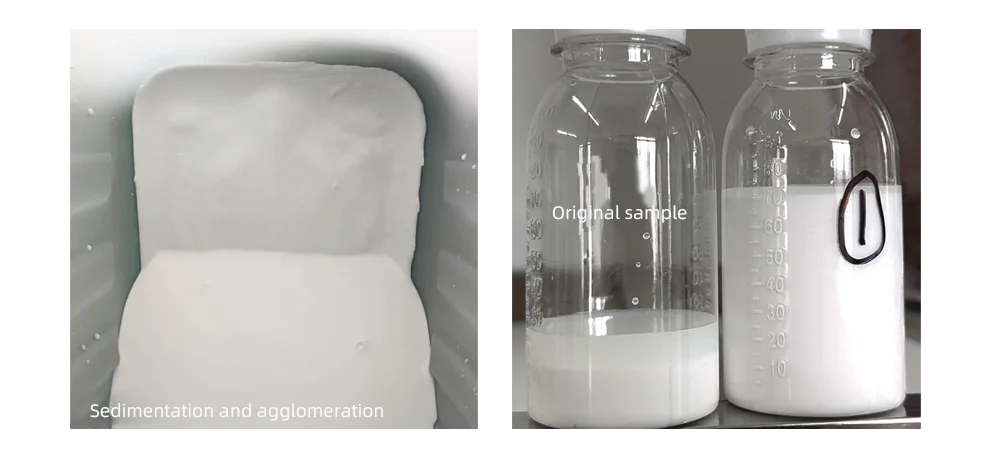
During electrode slurry preparation and solid electrolyte processing, problems such as particle agglomeration, uneven dispersion, poor interfacial contact, and inconsistent material properties can significantly reduce battery efficiency and cycle life.
To overcome these challenges, advanced dispersion technologies are becoming increasingly important. Among them, the high pressure microfluidic homogenizer provides an innovative solution by using extreme shear forces, cavitation effects, and high-frequency impact energy to achieve nano-scale material dispersion and improve the quality of solid-state battery materials.
Why Material Dispersion Is Critical for Solid-State Batteries
The performance of solid-state batteries largely depends on the microstructure and uniformity of their functional materials.
Key materials involved in solid-state battery manufacturing include:
- Cathode active materials
- Solid electrolyte powders
- Conductive additives
- Polymer-based solid electrolytes
- Silicon and lithium-based anode materials
These materials often contain particles ranging from micrometers to nanometers. Without effective dispersion, particles tend to form aggregates, leading to several problems:
Particle Agglomeration
Nanomaterials naturally have high surface energy, making them prone to aggregation. Large clusters reduce active surface area and prevent uniform contact between battery components.
Poor Interface Contact
Solid-state batteries require intimate contact between electrodes and electrolytes. Uneven particle distribution can create gaps and increase interfacial resistance, limiting lithium-ion migration.
Inconsistent Electrochemical Performance
Material inconsistency may result in:
- Reduced energy density
- Lower charging efficiency
- Faster capacity degradation
- Poor batch-to-batch reproducibility
Therefore, achieving precise and stable dispersion is essential for improving solid-state battery manufacturing processes.
How Microfluidic Technology Enables Advanced Battery Material Processing
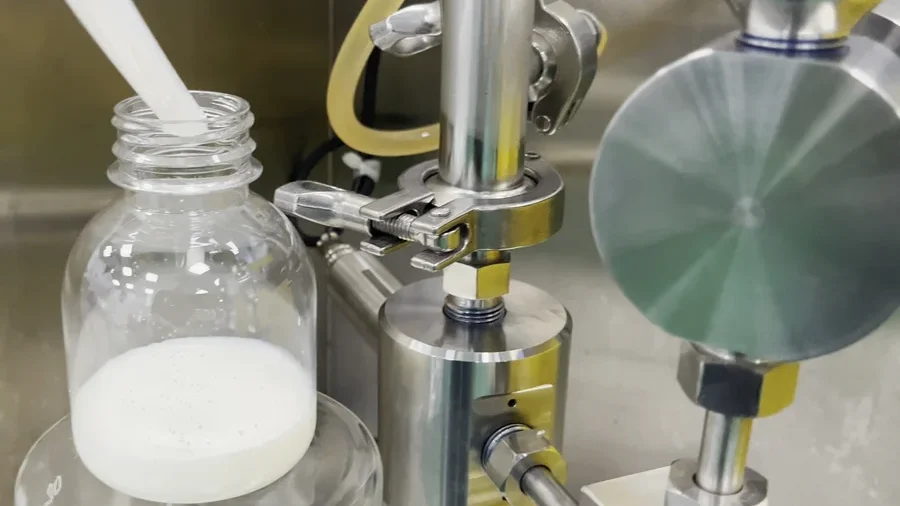
The ultra-high-pressure microfluidic homogenizer uses a purely physical process to high-pressure treat the mixed system of solid-state electrolyte components, including electrolyte salts, polymer matrices, inorganic fillers, and additives. As the material passes through the microchannels of the diamond interaction chamber, it is instantly subjected to intense shear forces, impact forces, and cavitation effects, efficiently breaking up agglomerates among inorganic fillers, promoting uniform dispersion of electrolyte salts, and improving the compatibility between the polymer matrix and inorganic fillers.
Unlike traditional mixing methods, which mainly rely on mechanical stirring or ultrasonic treatment, microfluidic processing generates intense physical effects at the microscale, including:
- High-speed fluid collision
- Strong shear forces
- Turbulent mixing
- Cavitation effects
- Pressure-driven particle interaction
These mechanisms effectively break down particle clusters and create highly uniform dispersions.
For solid-state battery applications, microfluidic technology helps achieve:
- Smaller particle size distribution
- Improved material uniformity
- Enhanced electrolyte-electrode contact
- More stable composite structures
As battery materials continue moving toward nanoscale engineering, microfluidic processing provides a more precise and scalable approach compared with conventional dispersion methods.
JUNJIE High Pressure Homogenization for Efficient Solid-State Electrolyte Preparation
We offer a customized ultra-high-pressure homogenization solution for solid-state electrolytes. The system applies purely physical high-pressure treatment, generating strong shear, impact, and cavitation forces through precision microchannels. It breaks up filler agglomerates, ensures uniform salt dispersion, and enhances polymer–filler compatibility. Adjustable pressure and cycle parameters enable fully tailored preparation, maximizing ionic conductivity and mechanical stability.
Experimental Plan
300 MPa processing with 40, 50, 55, and 60 cycles, with samples taken at each stage for testing and analysis.
Experimental Conclusion
Taking solid electrolyte as an example, after cyclic treatment at 300 MPa, the experimental results are as follows:
| Indicator | Before Treatment | After Treatment (55th cycle) | Improvement Effect |
|---|---|---|---|
| Particle Size (D50) | 74 μm | 360.57 nm | Refined from micron to nanometer scale |
| Dispersion Uniformity (PDI) | 0.41 | 0.27 | Dispersion uniformity improved by approximately 34.1% |
| Large Particle Residue (D90) | 11241 nm | 590.59 nm | No significant large particle residue |
| Ionic Conductivity | 1.2×10⁻⁴ S/cm | 8.5×10⁻⁴ S/cm | Ionic conductivity significantly improved |
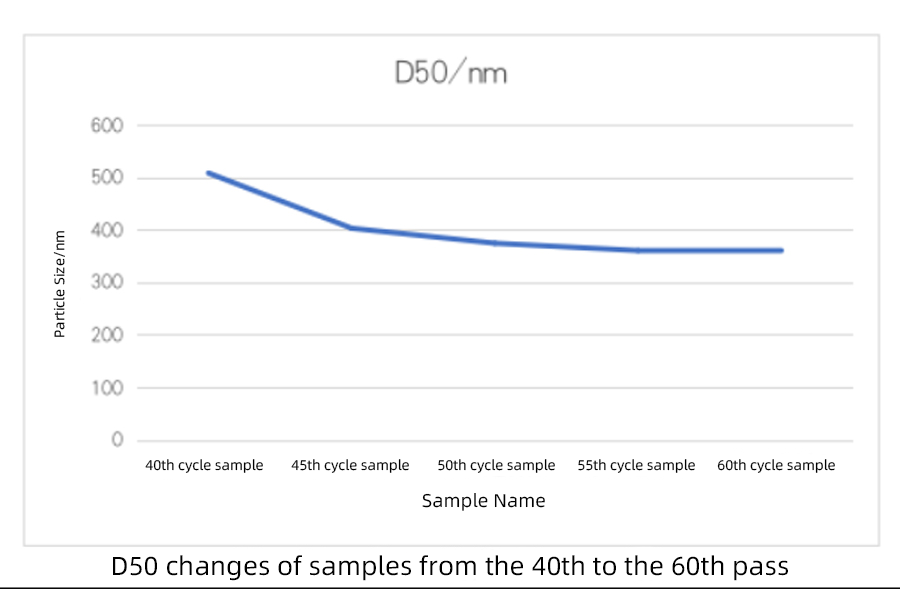
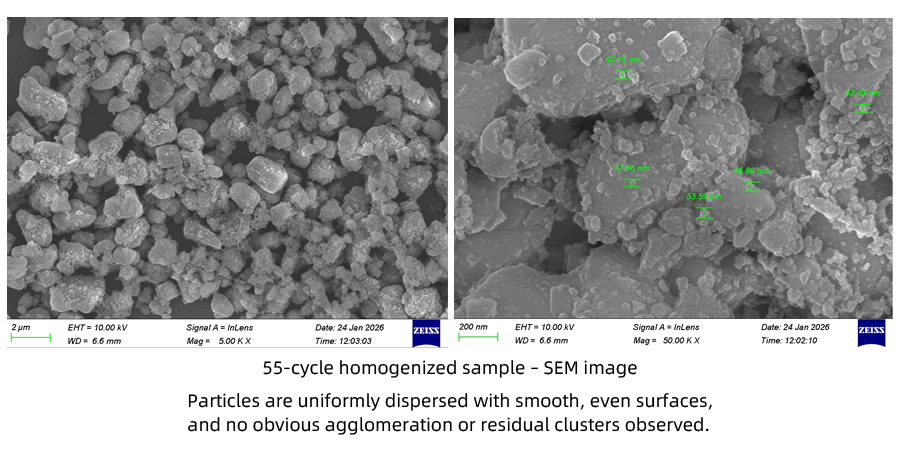
- Particle Size Refinement: The original particle size was 74 μm. After microfluidic homogenization, the overall D50 was controlled below 600 nm. The particle size was further refined from 508.36 nm at the 40th cycle to 360.57 nm at the 55th cycle, clearly demonstrating the effect of homogenization cycles on particle refinement in solid-state battery materials.
- Dispersion Optimization: Agglomerated inorganic fillers were effectively broken down. The PDI decreased from 0.41 at the 40th cycle to 0.27 at the 55th cycle, improving dispersion uniformity by approximately 34.1%. The particle size distribution became significantly more uniform, with no obvious large particle residues (D90 reduced from 11,241 nm before optimization to 590.59 nm at the 55th cycle).
- Performance Improvement: Based on optimized dispersion, ionic conductivity increased from 1.2 × 10⁻⁴ S/cm to 8.5 × 10⁻⁴ S/cm, while interfacial impedance between components was significantly reduced.
- Stability Enhancement: Mechanical stability and cycling performance of the electrolyte were improved. Meanwhile, agglomeration defects were reduced, effectively lowering the defect rate in production.
Advantages of Microfluidic Homogenization Compared with Traditional Methods
Traditional dispersion technologies such as ball milling, mechanical stirring, and ultrasonic processing have limitations when handling advanced battery materials.
| Processing Method | Limitations |
|---|---|
| Mechanical stirring | Limited dispersion ability for nano materials |
| Ultrasonic processing | Difficult to scale up for industrial production |
| Ball milling | May introduce contamination and excessive particle damage |
| High pressure microfluidic homogenization | Precise control, scalable, nano-level dispersion |
The advantages of high pressure microfluidic homogenizers include:
Precise Processing Control
Pressure parameters, processing cycles, and flow conditions can be accurately adjusted according to different battery material requirements.
Efficient Nano Dispersion Capability
The technology enables uniform dispersion of nanoparticles and advanced composite materials.
Industrial Scalability
Compared with laboratory-only techniques, modern microfluidic homogenization systems can be integrated into continuous production lines.
Applications of High Pressure Microfluidic Homogenizer in Solid-State Battery Materials
With continuous innovation in battery technology, microfluidic homogenization has broad application potential in:
Cathode Material Processing
Used for improving dispersion of:
- Lithium nickel manganese cobalt oxide (NMC)
- Lithium iron phosphate (LFP)
- High-nickel cathode materials
Better dispersion improves active material utilization and electrode consistency.
Solid Electrolyte Processing
Applicable to:
- Sulfide-based electrolytes
- Oxide ceramic electrolytes
- Polymer solid electrolytes
Microfluidic processing improves material uniformity and enhances interface compatibility.
Nano Composite Anode Materials
For advanced anode materials such as:
- Silicon nanoparticles
- Lithium metal composites
- Carbon-based nanomaterials
High-pressure homogenization helps create stable composite structures and improve cycling performance.
JUNJIE Microfluidic Homogenization Solutions for Advanced Battery Research
As a professional high pressure microfluidic homogenizer equipment provider, we focus on delivering advanced nano-material processing solutions for universities, research institutions, and industrial customers.
Our capabilities include:
- Independent R&D and manufacturing of core components
- Advanced pressure intensifier technology
- Self-developed homogenizing valves and diamond interaction chambers
- Complete microfluidic homogenizer manufacturing capabilities
- Customized processing solutions for different materials
- End-to-End Coverage: We provide comprehensive solutions ranging from small-scale laboratory trials to industrial-scale mass production.
- International Certifications: We hold international certifications such as ISO 9001 and ASME-U, and our products are exported to more than 20 countries and regions.
Through integrated R&D, production, testing, and service capabilities, our equipment supports applications in:
- Solid-state batteries
- New energy materials
- Nanomaterials
- Biopharmaceuticals
- Food and chemical industries
By combining microfluidic technology with high-pressure processing engineering, we help researchers achieve more precise material dispersion and accelerate the commercialization of next-generation battery technologies.
Conclusion: Microfluidic Technology Enables the Future of Solid-State Batteries
The advancement of solid-state batteries depends not only on material innovation but also on precise manufacturing technologies. Effective dispersion of solid state battery materials plays a crucial role in achieving higher energy density, improved safety, and longer battery life.
The high pressure microfluidic homogenizer provides a powerful solution by enabling nano-scale dispersion, improved material uniformity, and optimized interfaces.
As the battery industry moves toward higher-performance energy storage systems, advanced microfluidic processing technology will continue to play an important role in accelerating the development of next-generation solid-state battery manufacturing.