
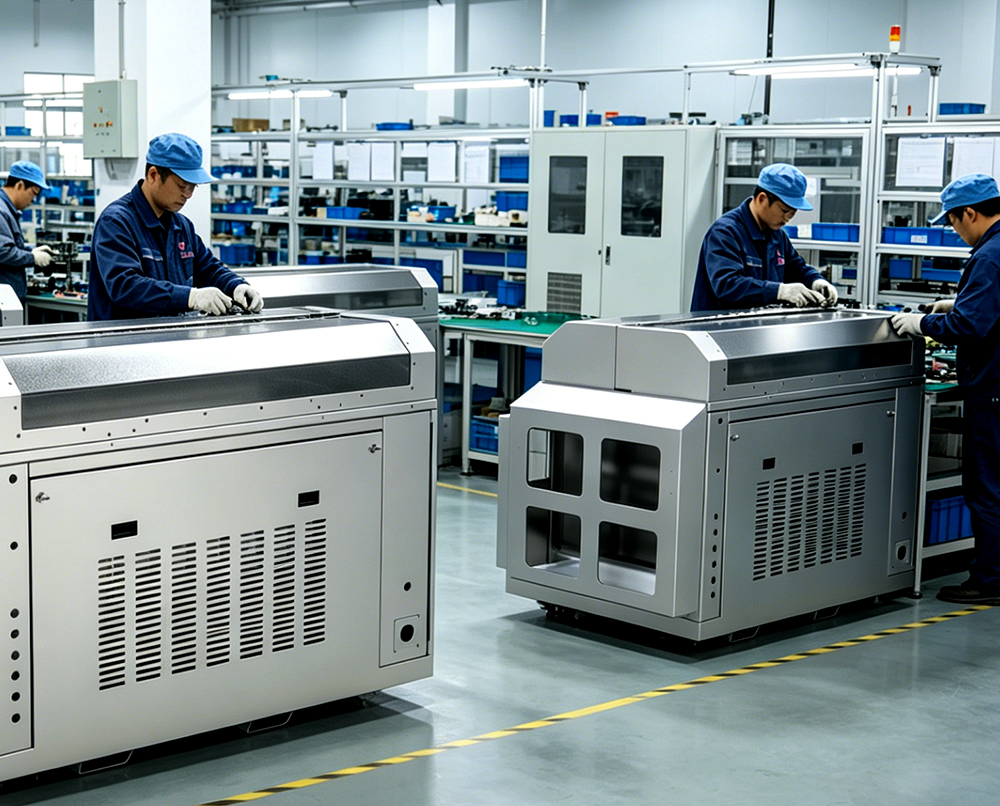
In advanced research and industrial production, every formulation has its own challenges. Whether developing next-generation nanomaterials, improving drug delivery systems, creating functional foods, or optimizing battery materials, the requirements for particle size, dispersion uniformity, processing pressure, and scalability can vary significantly.
A standard homogenization system may provide basic processing capabilities, but it often cannot fully meet the demands of complex formulations. This is where custom homogenization solutions become essential.
By combining advanced microfluidic technology, precision engineering, and flexible equipment design, modern high pressure homogenizer systems can be customized to match the specific requirements of different materials and applications.
As a professional microfluidic homogenization equipment provider, we focus on developing complete solutions from process optimization and core component manufacturing to equipment integration and technical support, helping customers achieve reliable nano-scale processing performance.
What Are Custom Homogenization Solutions?
Custom homogenization solutions refer to the design and optimization of homogenization equipment based on the unique characteristics of a customer’s materials, formulas, and production goals.
Unlike traditional “one-size-fits-all” equipment, customized systems consider multiple factors, including:
- Material properties
- Particle characteristics
- Required particle size distribution
- Viscosity and concentration
- Processing pressure requirements
- Production capacity
- Sterility and contamination control
- Scale-up requirements
A customized high pressure homogenizer allows researchers and manufacturers to precisely control the interaction between fluid dynamics, pressure energy, and material structure, achieving more predictable and repeatable results.
The Role of Microfluidic Technology in Customized Homogenization
At the core of advanced homogenization solutions is microfluidic technology.
Traditional mixing methods mainly rely on mechanical shear forces, which may have limitations when processing nano-scale materials. In contrast, microfluidic processing uses precisely designed microchannels to control fluid movement and create extremely high shear, impact, and cavitation effects.
A modern microfluidics homogenizer utilizes specialized interaction chambers where materials experience:
- High-speed microchannel collision
- Controlled turbulence
- Intense shear forces
- Pressure-driven particle disruption
- Uniform energy distribution
These mechanisms enable precise control of particle size reduction and dispersion quality.
For applications requiring nano-scale performance, microfluidic technology provides significant advantages, including:
- Smaller particle sizes
- Narrower particle size distribution
- Improved formulation stability
- Enhanced bioavailability
- Better material performance consistency
Why Choose a Customized High Pressure Homogenizer?
A high pressure homogenizer is widely used for preparing nano dispersions, emulsions, suspensions, and advanced functional materials. However, different applications require different equipment configurations.
1. Customized Pressure Configuration
Different materials require different processing pressures.
For example:
- Soft biological materials may require moderate pressure processing to preserve activity.
- Advanced nanomaterials may require higher pressure and stronger mechanical energy input.
- Battery materials may require optimized pressure cycles for uniform dispersion.
A customized system allows pressure ranges to be optimized according to the formula characteristics.
2. Specialized Homogenization Chambers
The interaction chamber is one of the most important components affecting homogenization performance.
Different formulas may require different chamber designs, such as:
- Y-type microchannels
- Z-type interaction chambers
- Diamond interaction chambers
- Customized flow structures
Through precise channel design, the system can optimize:
- Collision efficiency
- Energy transfer
- Particle fragmentation
- Processing stability
3. Material Compatibility and Processing Optimization
Different industries process completely different materials.
For example:
New Materials
Applications include:
- Graphene dispersion
- Carbon nanotube processing
- Ceramic slurry preparation
- Advanced composite materials
These materials often require strong dispersion capability and excellent wear resistance.
New Energy
Battery and energy storage materials require:
- Stable slurry preparation
- Uniform particle distribution
- Reduced agglomeration
- Improved electrode consistency
Customized homogenization systems help improve material uniformity and production reliability.
Biopharmaceutical Applications
In pharmaceutical research and production, precise processing is critical.
Applications include:
- Liposome preparation
- Nano drug delivery systems
- Vaccine formulations
- Biological sample processing
Microfluidics homogenizer technology provides gentle yet efficient processing, helping maintain sensitive biological structures while achieving nano-scale particle control.
Food and Chemical Industries
For food, cosmetics, and chemical formulations, homogenization performance directly affects product quality.
Applications include:
- Functional beverage emulsions
- Nano nutrition ingredients
- Cosmetic creams
- Polymer dispersions
Customized high pressure homogenizers improve:
- Texture consistency
- Shelf stability
- Product appearance
- Functional ingredient distribution
JUNJIE Customized Homogenization Solutions
JUNJIE offers high pressure homogenizer covering the full spectrum from lab-scale R&D to industrial-scale mass production. All models feature a unified design pressure of 420 MPa, ensuring linear scale-up of process parameters and a smooth transition from R&D outcomes to large-scale production.
Below are the three main equipment models from lab scale to mass production:
| Model | Positioning | Design Pressure | Flow Rate | Power | Boost Type | Key Features |
|---|---|---|---|---|---|---|
| HPW-10 | Lab Scale (R&D) | 420 MPa | 0.2 L/min | 3.7 kW | Single-acting | Servo direct drive, minimum sample volume 20 ml, suitable for small-batch, high-precision R&D |
| HPW-250 | Pilot Scale | 420 MPa | 4 L/min | 37 kW | Double-acting | Hydraulic drive, bridges lab and production, integrated CIP |
| HPW-500 | Production Scale | 420 MPa | 8 L/min | 75 kW | Double-acting | Supports CIP/SIP, capable of 24-hour continuous production, suitable for industrial-scale homogenization |
JUNJIE not only offers standardized lab-scale, pilot-scale, and production-scale equipment, but its core advantage lies in providing customized homogenization processes and stabilization solutions for complex systems and unique formulations. This is reflected in three dimensions: equipment customization, process development, and full-chain service.
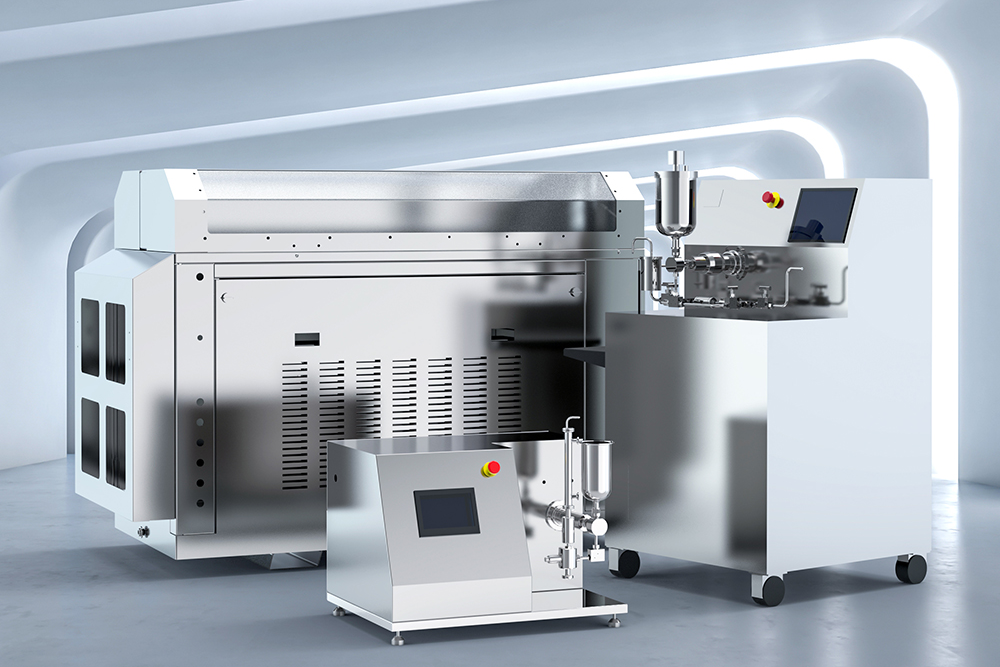
Equipment Customization: HPW-X Customized Models
For special requirements that standard models cannot meet, JUNJIE has launched the HPW-X Customized Microjet Homogenizer. This model supports on-demand customization and flexibly adapts to all scenarios including pharmaceuticals, food, and new materials:
- Pressure Customization: Design pressure can be tailored based on material characteristics, up to a maximum of 420 MPa.
- Flow Rate Customization: Different flow rate specifications are matched according to production capacity requirements.
- Material Customization: Specific materials can be selected for special corrosion resistance or high-purity requirements.
- Function Customization: Optional functions such as CIP (Clean-in-Place), SIP (Sterilization-in-Place), GMP data recording modules, and temperature control systems can be integrated to meet all scenarios from R&D to GMP production.
Core Processing Unit Customization
JUNJIE offers two core processing unit solutions, which can be selected or customized based on material characteristics and purity requirements:
- Diamond Interaction Chamber: Made entirely of diamond material, zero metal contamination, super wear-resistant, specifically designed for high-purity applications such as semiconductor MLCC slurries, CMP polishing fluids, and pharmaceutical injections.
- Homogenization Valve: Features a replaceable valve core + valve seat structure, cost-effective and easy to maintain, suitable for conventional scenarios where metal impurities are not a concern, such as food, chemical, and biological cell disruption, especially for high-viscosity and high-solid-content materials.
Process Development and Full-Chain Services
JUNJIE provides full-chain process customization services from “homogenization → dispersion → stabilization,” ensuring that technical solutions are truly implemented:
- Microjet Nano-Homogenization Materials Laboratory: Customers can send their materials for testing. Application engineers match pressure parameters and chamber models based on material characteristics and target particle size, conduct on-site testing, and issue detailed particle size distribution reports and process parameter recommendations.
- Process Scale-Up Data Transfer: Parameters verified on lab-scale equipment can be seamlessly transferred to pilot-scale and production-scale equipment, ensuring a smooth transition from R&D to mass production, reducing trial-and-error cycles.
- One-Stop Service: Provides full-cycle services from production line design, equipment assembly, to after-sales operation and maintenance, including free sample testing before sales, installation, commissioning, and operation training at delivery, as well as preventive maintenance, spare parts support, and technical consultation after sales.
Typical Application Cases
JUNJIE’s customized solutions have been successfully applied in multiple high-difficulty fields. The following are some case data:
| Field | Material | Core Challenge | JUNJIE Solution Effect |
|---|---|---|---|
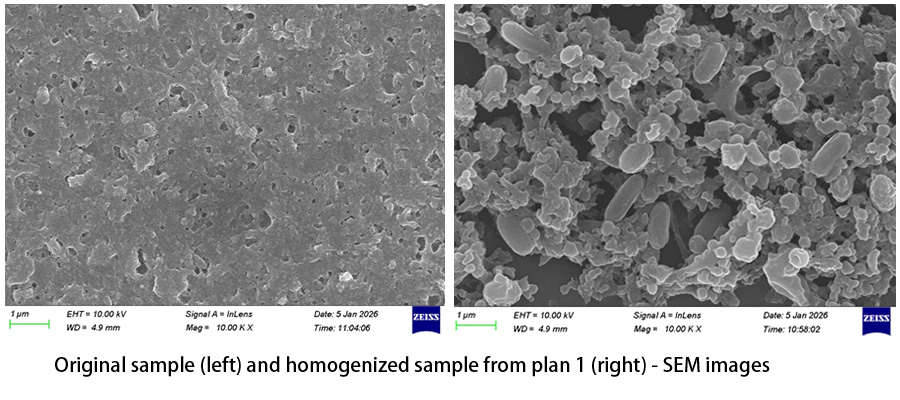
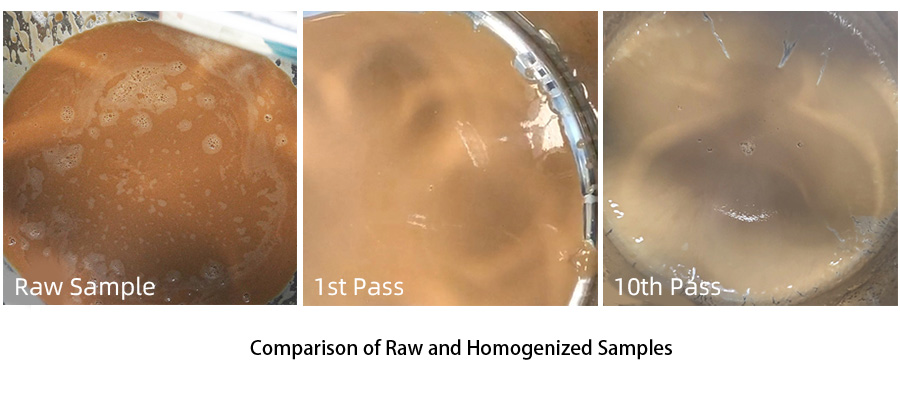
| Biomedicine | Bacillus subtilis cell disruption | Low disruption rate, loss of active ingredients | Disruption rate reached 75%-90%, active ingredient dissolution significantly increased, pass rate improved by 15% |
| Chemical Engineering | Oily pigment dispersion | Uneven dispersion, particle agglomeration | D90 reduced from 9875nm to 294.1nm, processing efficiency improved by over 65% |
| Materials Science | Quenched glass powder slurry | Particle agglomeration, insufficient surface modification | Average particle size reduced from 3μm to 260nm, PDI stable at 0.07-0.1 |
| Food & Beverage | Lycopene extraction | Low extraction efficiency, severe activity loss | Extraction rate increased from 38% to 82%, activity loss controlled within 8% |
| New Energy | Solid-state electrolyte | Filler agglomeration, low ionic conductivity | Particle size reduced from 74μm to 360.57nm, ionic conductivity improved by 7 times |
| Beauty & Personal Care | Silk solution | Uneven dispersion, high activity loss | Average protein molecule particle size reduced from 522nm to 310nm, dispersion uniformity improved by approximately 38.9% |
Conclusions from the Bacillus Subtilis Cell Disruption Experiment:
Conclusion
Every formulation has unique processing requirements. Achieving consistent nano-scale dispersion, precise particle size control, and stable performance requires more than standard equipment—it requires a customized homogenization solution tailored to specific materials and applications.
With advanced microfluidics homogenizer technology, high-performance high pressure homogenizer systems, and strong engineering capabilities, JUNJIE provide customized solutions for new materials, new energy, biopharmaceuticals, food, and chemical industries. Through independent R&D and manufacturing of core components, we help customers achieve reliable nano-scale processing from laboratory research to industrial production.