

Modern industries such as biotechnology, pharmaceuticals, food science, and advanced materials increasingly require precise control over particle size, molecular interactions, and material stability. Traditional mixing and homogenization methods often struggle to achieve consistent nanoscale processing, especially when dealing with complex biological structures, sensitive active ingredients, or advanced functional materials.
Ultra-high pressure microfluidization technology has emerged as a powerful solution for these challenges. By forcing materials through specialized microchannels under extremely high pressure, this technology creates intense shear forces, impact forces, and cavitation effects that enable efficient cell disruption, nano-scale dispersion, emulsification, and extraction.
A high pressure microfluidizer provides researchers and manufacturers with a versatile platform for improving processing efficiency and product performance. From breaking biological cell walls to enhancing drug delivery systems, its applications continue to expand across multiple industries.
Understanding High Pressure Microfluidizer Technology
A high pressure microfluidizer is an advanced processing system based on microfluidic principles. Unlike conventional homogenizers that rely mainly on mechanical shearing, microfluidic technology utilizes controlled fluid dynamics inside interaction chambers to generate extremely high energy environments.
During operation, materials are accelerated under high pressure and pass through specially designed microchannels or interaction chambers. The sudden velocity changes create:
- High shear stress
- Turbulence and collision effects
- Cavitation forces
- Rapid energy dissipation
These mechanisms enable precise particle size reduction and uniform dispersion while maintaining better control over processing conditions.
Compared with traditional high-pressure homogenizers, microfluidic systems offer advantages including:
- More consistent nanoscale particle distribution
- Improved repeatability
- Higher processing efficiency
- Better protection of sensitive materials
- Flexible adjustment for different formulations
The combination of advanced pressure control systems, precision interaction chambers, and optimized fluid pathways makes high pressure microfluidization an important platform for next-generation material processing.
Core Applications: Cell Disruption and Drug Extraction
Efficient Cell Disruption for Complete Release of Active Ingredients
In the biopharmaceutical field, many valuable active ingredients (e.g., proteins, nucleic acids, liposomes) are located inside cells. Traditional disruption methods (e.g., mechanical grinding, enzymatic digestion, ultrasonication) often suffer from low efficiency, high heat generation, and a tendency to destroy active ingredients.
The high pressure microfluidizer efficiently breaks down cell walls and membranes through its powerful physical shear forces, allowing intracellular substances to be fully released. Its advantages include:
- High Disruption Rate: The strong shear and cavitation effects under ultra-high pressure instantly tear cell structures, achieving a disruption rate far exceeding traditional methods.
- Activity Retention: The equipment can be equipped with a precise temperature control system to effectively manage material temperature, preventing the inactivation of heat-sensitive active ingredients (e.g., vaccines, antibodies) caused by localized overheating, thus maximizing their biological activity.
- Batch-to-Batch Consistency: The use of a diamond interaction chamber with a fixed geometry ensures highly consistent processing conditions each time, resulting in stable and uniform products across batches, meeting GMP production requirements.
Nanomedicine Preparation for Enhanced Bioavailability
Preparing poorly soluble drugs or active ingredients into nanoscale particles is an effective way to improve their solubility and bioavailability. The high pressure microfluidizer is an ideal tool for preparing nanomedicines (e.g., liposomes, nanoemulsions, nanosuspensions).
- Liposome and Nanodrug Preparation: By precisely controlling pressure and the number of cycles, phospholipids and drug molecules can be uniformly dispersed to form liposomes or nanoparticles with an extremely narrow particle size distribution (PDI < 0.12) and high stability. This is crucial for targeted drug delivery and sustained-release formulation development.
- Precise Particle Size Control: The equipment offers pressure control accuracy of ±0.5%, enabling precise regulation of nanoparticle size to meet the specific requirements of different drug delivery systems.

Extended Application Fields: From Laboratory to Industrial Production
JUNJIE’s series of high pressure microfluidizer seamlessly bridge the gap from laboratory R&D to industrial-scale production. Their multifunctional applications span several key sectors:
| Application Field | Typical Application Scenarios | Core Value |
|---|---|---|
| Biopharmaceuticals | Vaccines, monoclonal antibodies, recombinant proteins, liposomal nanodrugs | Efficient disruption, activity retention, sterile compliance, batch consistency |
| Chemical Engineering | Polymerization, catalyst preparation, colloidal dispersion | Accelerated reaction kinetics, enhanced product purity, suppressed agglomeration |
| Materials Science | Graphene dispersion, ceramic powders, high-performance composites | Nanoscale uniform dispersion, optimized material microstructure, enhanced performance |
| Food & Beverage | Plant-based emulsions, nano fish oil, functional beverages | Ultra-high pressure sterilization, improved taste and stability, retained nutrition |
| New Energy | Battery material (cathode/anode slurry) homogenization, fuel cell raw materials | Uniform dispersion of active materials, improved battery performance and cycle life |
| Cosmetics & Personal Care | Nano creams, serums, functional skincare products | Enhanced product texture, increased active ingredient penetration, extended shelf life |
Why Choose High Pressure Microfluidizer Technology
As industries move toward nano-scale manufacturing and precision processing, traditional technologies face increasing limitations.
High pressure microfluidizers provide several critical advantages:
Superior Nano-Scale Processing Capability
Controlled microchannel interaction enables precise particle size reduction and uniform distribution.
Improved Product Stability
Smaller and more evenly distributed particles often improve:
- Suspension stability
- Emulsion lifetime
- Bioavailability
- Functional performance
Flexible Processing Solutions
A single platform can support diverse materials, from biological samples to industrial formulations.
Reliable Scale-Up Performance
Advanced high-pressure systems allow seamless transition from laboratory research to industrial production.
The Future of Microfluidic Technology in Industrial Processing
As demand grows for personalized medicine, sustainable materials, functional foods, and advanced energy solutions, microfluidic technology will continue playing a critical role.
Future developments will focus on:
- Higher pressure processing capabilities
- Intelligent process monitoring
- Automated control systems
- More efficient interaction chamber designs
- Customized solutions for specialized materials
Companies with complete engineering capabilities, including independent development of core components such as intensifiers and diamond interaction chambers, will be better positioned to provide reliable and scalable microfluidic processing solutions.
Equipment Advantages: JUNJIE High Pressure Microfluidizer
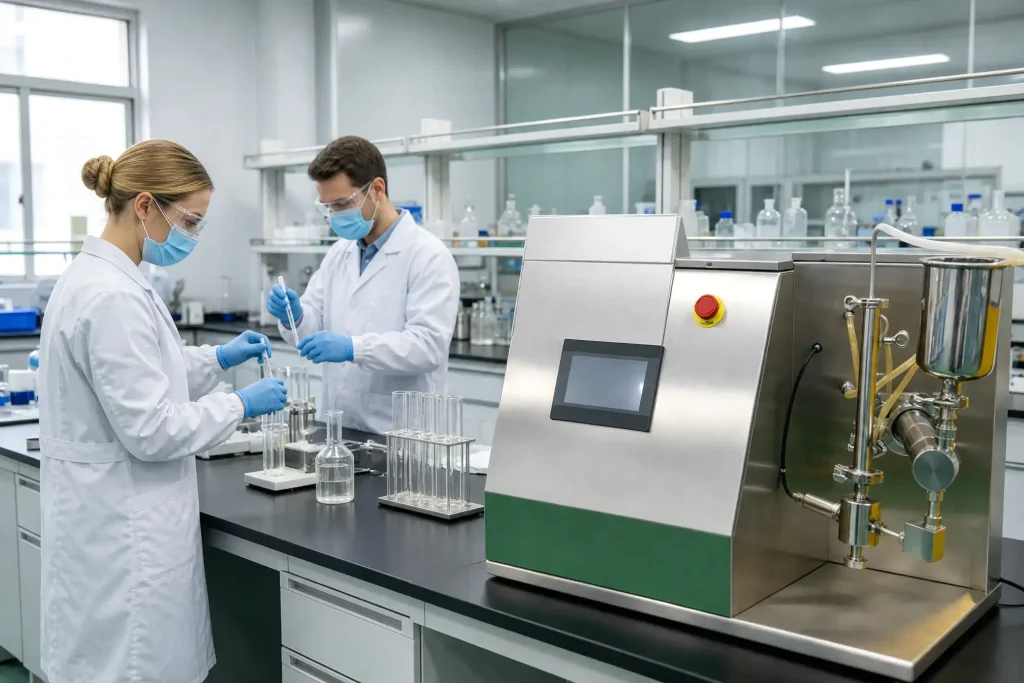
As an innovative company specializing in high pressure microfluidizer, JUNJIE’s product series (e.g., lab-scale HPW-10, pilot-scale HPW-250, production-scale HPW-500, and customized HPW-X) offer the following core advantages to ensure efficiency and reliability at every stage, from cell disruption to drug extraction:
- Core Technology: Utilizes a diamond interaction chamber with fixed internal microchannels, ensuring stable and uniform particle size results across batches.
- Ultra-High Pressure Performance: Maximum pressure up to 420 MPa, meeting the most demanding nanodispersion requirements.
- Hygienic Design: All contact materials are GMP and FDA-compliant, such as 316L stainless steel, with integrated CIP/SIP in-situ backflushing systems to ensure a sterile production environment.
- Micro-Volume Processing Capability: The lab-scale HPW-10 supports processing volumes as low as 20 ml, significantly saving valuable samples.
- Intelligent Control: Equipped with a high-definition touchscreen control system, supporting data traceability, remote monitoring, and recipe storage to meet data compliance requirements.
Conclusion: One Technology, Multiple Possibilities
From cell disruption to drug extraction, ultra-high pressure microfluidization has demonstrated exceptional versatility across biotechnology, pharmaceuticals, food, cosmetics, and advanced materials.
With precise control, powerful processing capabilities, and broad microfluidics applications, high pressure microfluidizers are becoming essential tools for researchers and manufacturers seeking nano-scale innovation.
By combining advanced microfluidic technology, high-pressure engineering, and customized processing solutions, next-generation homogenization systems provide a reliable pathway toward improved product performance, higher efficiency, and industrial advancement. The JUNJIE brand is committed to providing full-process solutions from R&D to production, empowering the high-end manufacturing needs of global customers.