
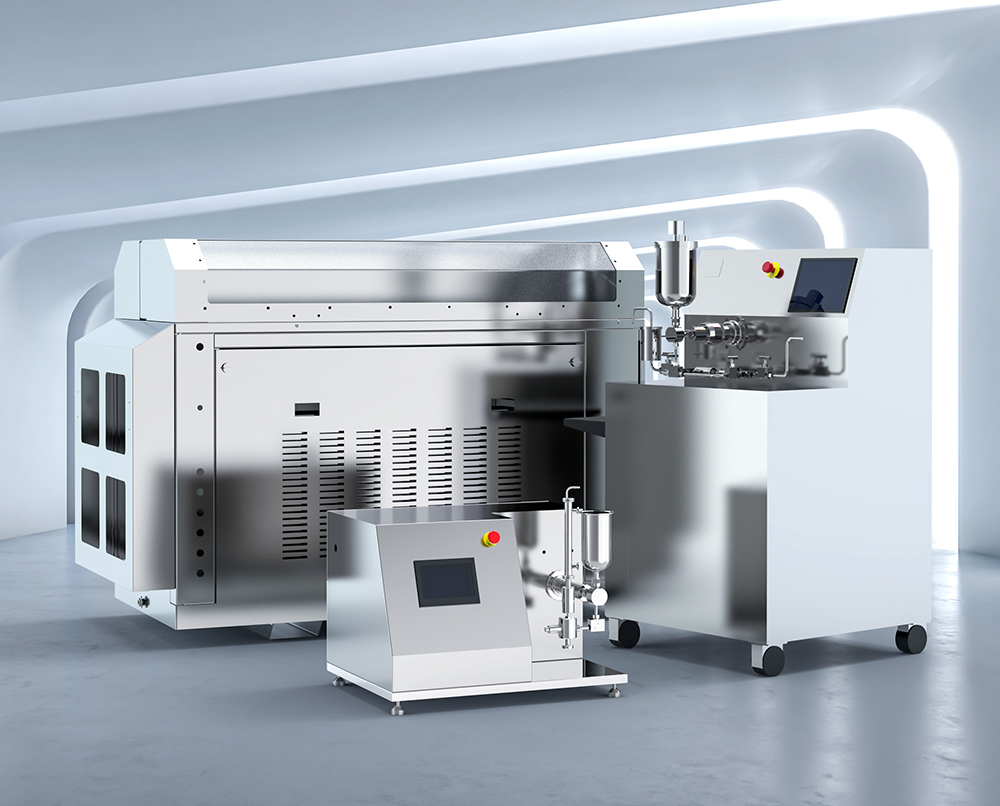
High pressure homogenization has become one of the most important technologies for particle size reduction, emulsification, cell disruption, and material dispersion. Today, it plays a critical role in industries ranging from pharmaceuticals and biotechnology to food processing, cosmetics, chemicals, and advanced materials.
As manufacturers continue to pursue higher product quality, greater production efficiency, and improved process consistency, high pressure microfluidic technology provides a reliable solution capable of producing stable, uniform, and high-performance products.
This article explains how high pressure homogenization works, its major advantages, and the industries where it delivers the greatest value.
What Is High Pressure Homogenization ?
High pressure homogenization is a mechanical process that forces liquid suspensions through a specially engineered interaction chamber or homogenizing valve under extremely high pressure, typically ranging from 50 MPa to over 400 MPa.
During this process, the fluid experiences multiple physical forces simultaneously, including:
- Extreme shear
- High-velocity impact
- Turbulence
- Cavitation
- Collision
These combined forces rapidly break down droplets, particles, fibers, or cells into much smaller and more uniform sizes.
Unlike chemical processing methods, high pressure homogenization achieves particle refinement using purely physical forces, making it suitable for sensitive biological and pharmaceutical products.
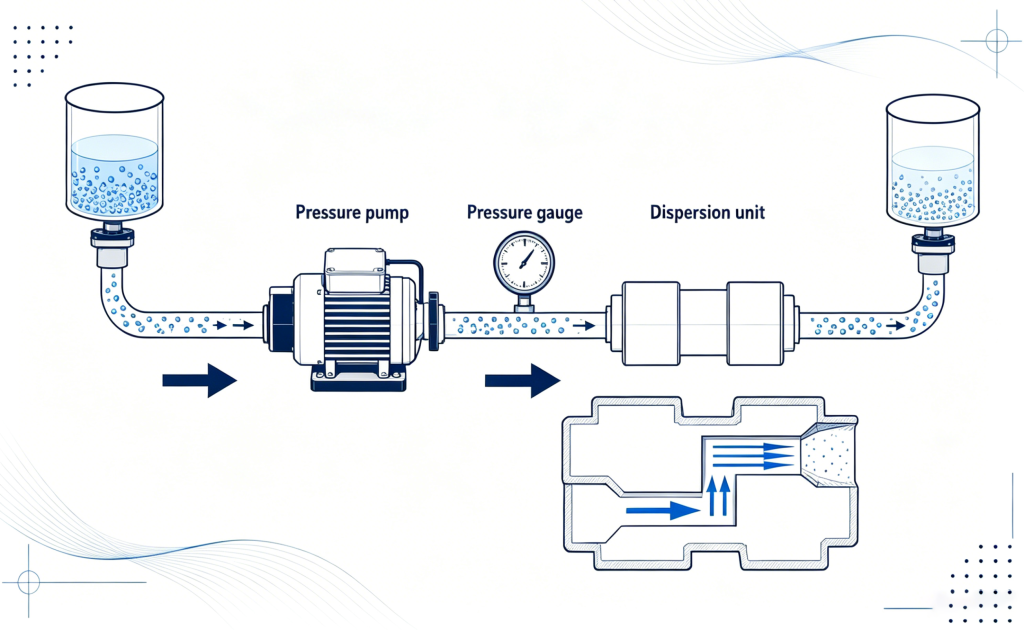
How Does a High Pressure Homogenization Work?
A typical high pressure homogenizer consists of several key components:
- High-pressure pump
- Pressure intensifier
- Homogenizing valve or microfluidic interaction chamber
- Cooling system
- Product collection system
The working process can be summarized in four steps.
Step 1. Product Pressurization
The product is pumped into the system and compressed to the desired operating pressure.
Step 2. High-Speed Acceleration
The pressurized fluid passes through a very narrow chamber, where velocity increases dramatically.
Step 3. Particle Breakdown
Within milliseconds, intense shear, turbulence, cavitation, and particle collisions reduce droplet and particle sizes.
Step 4. Stable Product Formation
After multiple homogenization passes, the product achieves a highly uniform particle size distribution and improved stability.
Key Advantages of High Pressure Homogenization
Compared with conventional mixing technologies, high pressure homogenization offers several significant advantages.
Superior Particle Size Reduction
Particles can often be reduced to submicron or nanometer sizes, depending on the material and process conditions.
Benefits include:
- Improved suspension stability
- Faster dissolution
- Better bioavailability
- Enhanced product appearance
Excellent Emulsion Stability
Uniform droplet sizes significantly reduce:
- Creaming
- Sedimentation
- Phase separation
This results in longer shelf life and improved product consistency.
Efficient Cell Disruption
For biotechnology applications, high pressure homogenizers efficiently rupture microorganisms such as:
- E. coli
- Yeast
- Algae
- Bacteria
This enables efficient extraction of:
- Proteins
- DNA
- RNA
- Enzymes
- Intracellular metabolites
Highly Reproducible Results
Modern automated homogenizers precisely control:
- Pressure
- Flow rate
- Temperature
- Number of passes
This ensures consistent batch-to-batch production.
Scalable Manufacturing
One of the biggest advantages of high pressure homogenization technology is its scalability.
The same processing principles apply from:
- Laboratory research
- Pilot production
- Commercial manufacturing
This simplifies process development and technology transfer.
Chemical-Free Processing
Because homogenization relies on mechanical energy rather than chemical additives, it is compatible with clean-label food products and sensitive pharmaceutical formulations.
Major Industrial Applications
Biopharmaceuticals
Biotechnology companies use high pressure homogenizers for:
- Cell disruption
- Vaccine production
- Protein extraction
- Monoclonal antibody processing
- Gene therapy development
- mRNA manufacturing
The technology enables efficient recovery of valuable intracellular products while preserving biological activity.
Nanomedicine
Particle size is crucial for drug delivery systems.
High pressure homogenization is widely used to produce:
- Liposomes
- Lipid nanoparticles (LNPs)
- Nanoemulsions
- Nanocrystals
- Polymer nanoparticles
Smaller particle sizes often improve drug absorption and therapeutic effectiveness.
Food and Beverage Processing
The food industry uses high pressure homogenization to improve:
- Milk
- Plant-based beverages
- Fruit juices
- Dairy products
- Sauces
- Nutritional drinks
Benefits include:
- Better texture
- Improved mouthfeel
- Enhanced stability
- Reduced separation
- Longer shelf life
Cosmetics and Personal Care
Manufacturers use homogenization to create:
- Creams
- Lotions
- Serums
- Sunscreens
- Cosmetic emulsions
Uniform droplet distribution improves:
- Product appearance
- Stability
- Skin absorption
- Sensory experience
Chemical and Material Processing
High pressure homogenization is increasingly used for dispersing advanced materials, including:
- Graphene
- Carbon nanotubes
- Ceramic nanoparticles
- Pigments
- Functional coatings
Uniform dispersion enhances material performance and processing consistency.
Future Trends in High Pressure Homogenization Technology
As industries demand higher precision and efficiency, several trends are shaping the future of high pressure homogenization:
- Intelligent process monitoring with real-time data acquisition
- AI-assisted parameter optimization for improved consistency
- Energy-efficient system designs that reduce operating costs
- Continuous processing solutions for large-scale production
- Expanded applications in nanotechnology and advanced biomaterials
- Integration with automated manufacturing and digital quality control systems
These advancements will continue to improve product quality while supporting sustainable and scalable manufacturing.
Core Advantages of JUNJIE High Pressure Homogenization Technology
JUNJIE high pressure homogenization technology offers the following core advantages:
- Activity Preservation, Controllable Quality: Purely physical processing with no introduction of impurities. The degree of cell disruption or dispersion can be precisely controlled, maximizing the retention of active ingredients in the material and significantly improving the product qualification rate.
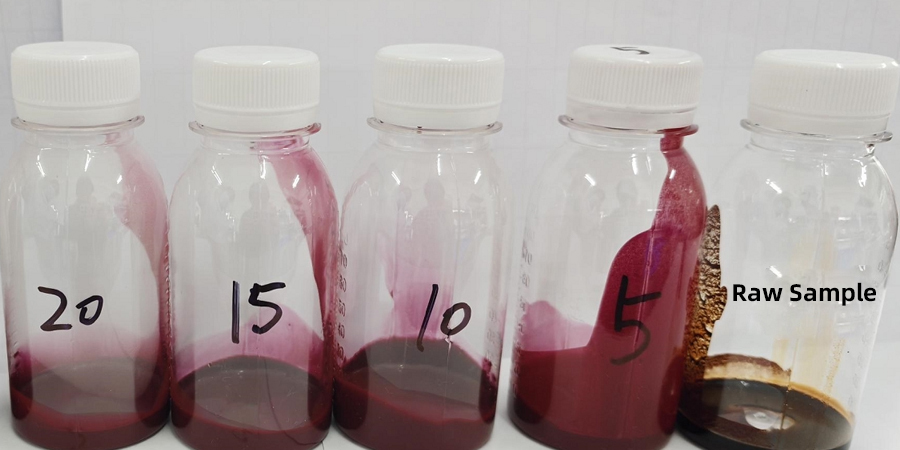
- High Efficiency, Scalable Stability: High processing efficiency with significant improvements over traditional processes (e.g., >65% increase in dispersion efficiency for oil-based pigments). Batch consistency can reach over 98.5%, making it suitable for large-scale production.
- Mature Technology, Cost and Energy Reduction: Core components are independently developed, ensuring stable operation. Comprehensive energy consumption can be reduced by approximately 30% – 40% compared to traditional processes.
- Precision, Efficiency, Strong Adaptability: The microchannel provides precise shear, enabling a “disruption-dispersion” process in a single step. One machine can serve multiple purposes, improving equipment utilization.
JUNJIE High Pressure Homogenization Applications
JUNJIE high pressure homogenization applications span multiple industries, as follows:
| Application Field | Typical Material/Case | Processing Effect (Example) |
|---|---|---|
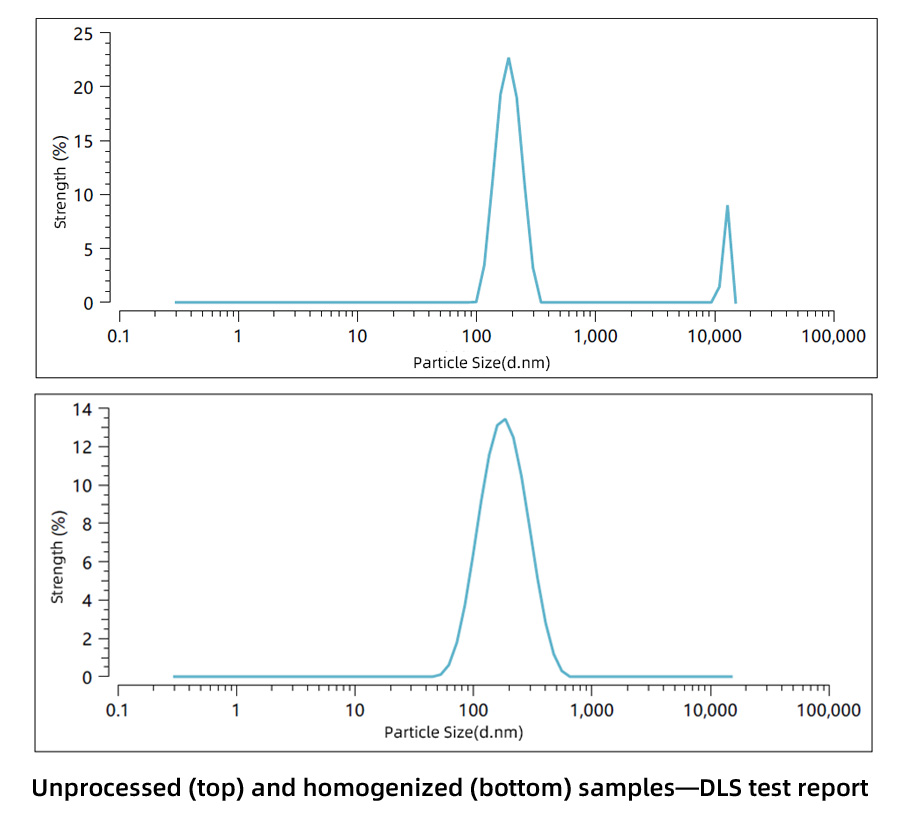
| Biopharmaceuticals | Bacillus subtilis cell disruption | Disruption rate reaches 75%-90%, D90 particle size reduced from 10,367.68nm to 3,533.18nm, significantly increased active ingredient dissolution, 15% improvement in qualification rate, 30% reduction in energy consumption. |
| Chemical Engineering | Oil-based pigment dispersion | At 270MPa for 10 cycles, D90 reduced from 9,875nm to 294.1nm, PDI from 0.423 to 0.156, processing efficiency improved by >65%, batch consistency reached 98.5%, energy consumption reduced by approximately 40%. |
| Materials Science | Quenched glass powder slurry | Average particle size reduced from 3μm to 260nm, PDI stable at 0.07-0.1, excellent dispersion uniformity, energy consumption reduced by approximately 32%. |
| Food & Beverage | Lycopene extraction | Extraction rate increased from 38% to 82%, particle size reduced from 80μm to 3μm, activity loss controlled within 8%, energy consumption reduced by approximately 30%. |
| New Energy | Solid-state electrolyte | Particle size reduced from 74μm to 360.57nm, ionic conductivity increased from 1.2×10⁻⁴ S/cm to 8.5×10⁻⁴ S/cm, batch consistency reached >98.5%, energy consumption reduced by 38%. |
| Beauty & Personal Care | Silk fibroin solution | Average protein molecular particle size reduced from 522nm to 310nm, PDI from 0.416 to 0.254, dispersion uniformity improved by approximately 38.9%, energy consumption reduced by 25%-30%. |
Furthermore, this technology is also widely applied in high-end fields such as semiconductor electronic materials (e.g., CMP slurries), graphene dispersion, and liposome preparation.
Conclusion
High pressure homogenization has become an indispensable technology across the pharmaceutical, biotechnology, food, cosmetics, and materials industries. By using intense mechanical forces to reduce particle size, create stable emulsions, and disrupt cells, it enables manufacturers to achieve higher product quality, greater consistency, and more efficient production.
As research and industrial manufacturing continue to evolve, high pressure homogenization technology will play an increasingly important role in developing innovative products, scaling production, and meeting the growing demand for precision processing.
For companies seeking to enhance product quality, optimize production efficiency, and strengthen their market competitiveness, investing in an advanced high pressure homogenizer such as JUNJIE is a strategic choice. It not only meets today’s production requirements but also provides a solid foundation for future technological innovation, process scalability, and long-term business growth.