
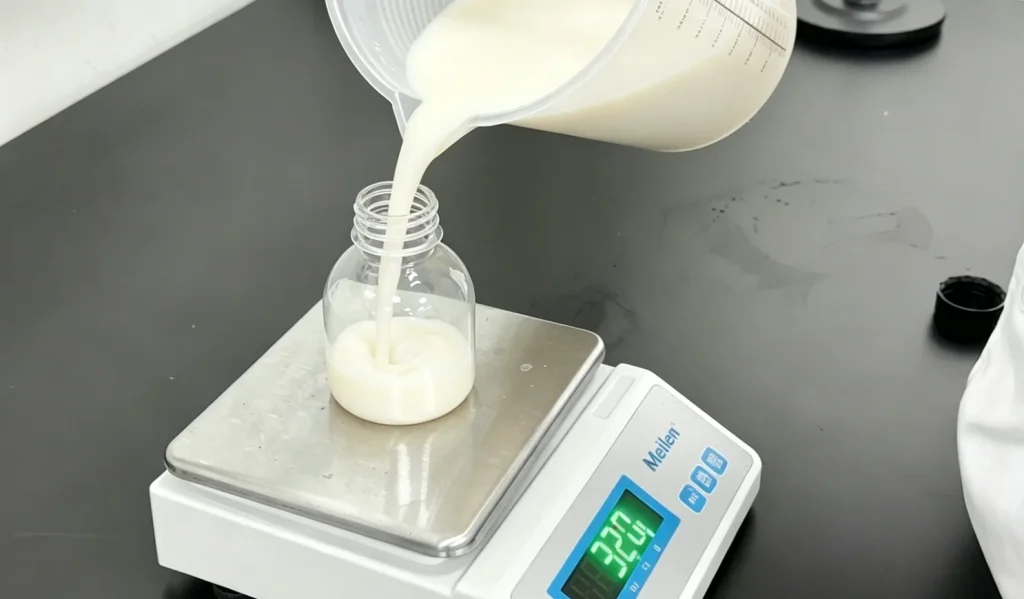
Milk is one of the most widely consumed nutritional foods worldwide, providing essential nutrients such as protein, calcium, vitamins, and minerals. However, many consumers have questions about how milk processing methods affect its nutritional value and health benefits.
One common question is: Is homogenized milk good for you?
Homogenized milk has become the standard choice in modern dairy production because it provides a smoother texture, improved stability, and a more consistent drinking experience. Unlike traditional milk where fat naturally separates and rises to the surface, homogenized milk undergoes a mechanical process that reduces fat globules into smaller and more evenly distributed particles.
With the development of advanced processing technologies, including high pressure homogenizer systems and microfluidic technology, dairy manufacturers can achieve finer particle control while maintaining the natural quality of milk.
This article explains what homogenized milk is, its health benefits, and how advanced homogenization technology improves dairy products.
What Is Homogenized Milk?
Homogenized milk is milk that has been processed to evenly distribute fat particles throughout the liquid.
In natural milk, fat exists as relatively large globules that naturally separate over time, creating a cream layer on the surface. During homogenization, milk passes through a high-pressure processing system where intense mechanical forces break down these fat globules into much smaller particles.
The result is:
- A uniform milk structure
- Smoother mouthfeel
- Reduced fat separation
- Improved product stability
- Consistent quality during storage
Modern dairy manufacturers typically use high-pressure homogenization equipment to achieve precise particle size reduction and stable emulsification.
Health Benefits of Homogenized Milk: From Technology to Truth
The health effects of milk homogenization go far beyond improving texture and mouthfeel. At its core, homogenization changes the physical structure of fat globules, which can influence how the human body digests and absorbs fats and nutrients.
1. Improved Nutrient Absorption, Especially Calcium
The homogenization process breaks down fat globules into nanoscale particles (<100 nm), dramatically increasing their surface area. This allows digestive enzymes, such as lipase, to interact with and break down fat more efficiently, potentially improving fat digestion and absorption.
More importantly, available research suggests that calcium in milk is closely associated with the digestion of milk fat. Homogenization may improve calcium bioavailability, with some sources reporting increases in calcium absorption of up to 50%. This could be particularly beneficial for children, adolescents, and older adults who need adequate calcium intake.
2. Easier Digestion and Reduced Gastrointestinal Burden
For people with lactose intolerance or weaker digestive function, homogenized milk may be a more comfortable option. Smaller fat globules can reduce the digestive workload and may help alleviate digestive discomfort such as bloating.
At the same time, homogenization itself is a non-thermal processing technique that can help improve the physical stability of milk. When combined with appropriate pasteurization or sterilization processes, it can contribute to food safety while helping preserve heat-sensitive nutrients such as vitamins A and C.
3. Supporting the Development of Functional Foods
Homogenization technology has opened new possibilities for developing more functional dairy products. For example, homogenization can be used to produce stable dairy products enriched with specific fatty acids or probiotics.
It can also support the development of functional fresh milk products designed to meet the health-management needs of different consumer groups. In yogurt production, for example, optimized homogenization can help control post-acidification, potentially extending shelf life while maintaining product activity and desirable texture.
Technical Expertise and Engineering Capabilities: The Power Behind Homogenized Milk
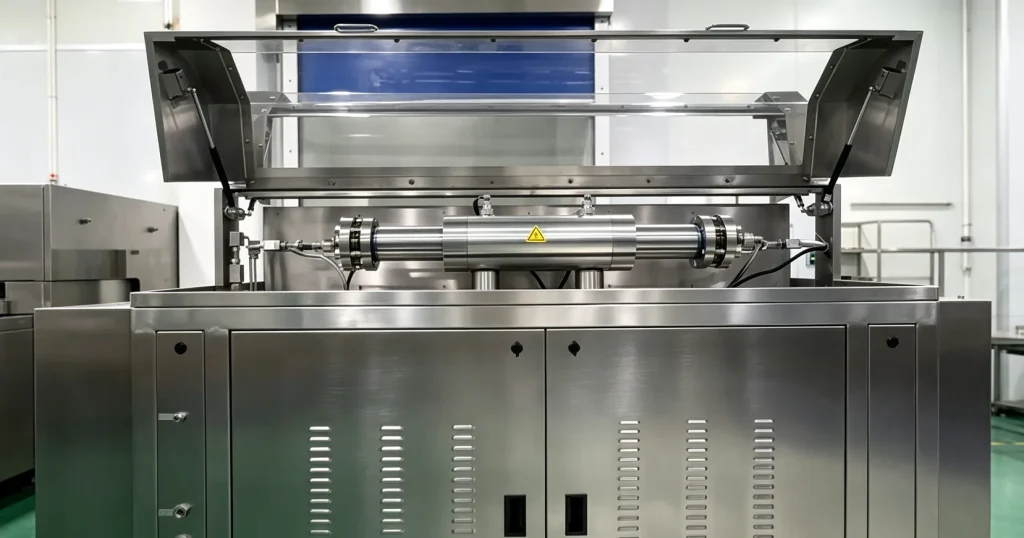
The key to achieving these potential benefits lies in high-pressure homogenization technology. This technology is far more than simple mixing. It is a sophisticated engineering process that combines fluid dynamics, materials science, and precision control.
Core Principle: Cavitation, Impact, and Shear
The working principle of a high-pressure homogenizer can be summarized as “high-pressure release and instantaneous disruption.”
Driven by a high-pressure pump, the milk is pressurized to extremely high pressures—up to 1,500 bar or even higher—and then forced through an extremely narrow flow restriction.
At this moment, the pressure drops rapidly, generating intense cavitation, high-velocity impact, and powerful shear forces within the fluid. These forces break down the fat globules into much smaller particles. This process is at the heart of achieving nanoscale particle-size control.
Technical Advantages: From Laboratory Research to Industrial Production
Precise Particle-Size Control
Modern homogenizers are equipped with high-precision pressure sensors and variable-frequency control systems, enabling precise control of homogenization pressure and fine adjustment of the final particle size. This helps ensure high consistency between production batches.
For example, particle sizes can be uniformly reduced to below 100 nm, with a disruption rate exceeding 95%.
Superior Engineering Capabilities
Equipment is manufactured using food- and pharmaceutical-grade 316L stainless steel to ensure hygienic and safe processing. Critical components, such as homogenization valves, can be manufactured from diamond materials, offering excellent wear and corrosion resistance for long-term stable operation.
Mechanical safety valves provide overload protection, further improving production safety.
Intelligent Processing Capabilities
Advanced homogenizers can integrate CIP/SIP (Clean-in-Place/Sterilization-in-Place) systems to support online cleaning and sterilization, meeting stringent production standards such as GMP.
Precision temperature-control systems, including plunger cooling, can effectively regulate product temperature during processing and help protect heat-sensitive nutrients from excessive thermal degradation.
Applications of Advanced Homogenization Technology in Dairy Industry
High pressure homogenizer and microfluidic technology are increasingly applied in:
Functional Dairy Beverages
For products containing:
- Protein
- Vitamins
- Minerals
- Probiotics
advanced homogenization improves stability and prevents ingredient separation.
Plant-Based Milk Alternatives
Products such as:
- Almond milk
- Soy milk
- Oat milk
require excellent emulsion stability because plant-based ingredients naturally separate.
High-pressure homogenization improves:
- Smoothness
- Suspension stability
- Consumer acceptance
Infant Nutrition Products
Infant formulas require extremely strict quality control.
Advanced homogenization technologies help achieve:
- Uniform nutrient distribution
- Stable formulations
- Consistent particle structure
Homogenized Milk vs Non-Homogenized Milk: Which Is Better?
| Feature | Homogenized Milk | Non-Homogenized Milk |
|---|---|---|
| Fat distribution | Uniform | Natural separation |
| Texture | Smooth and creamy | More traditional |
| Stability | Higher | Lower |
| Processing level | More controlled | Minimal processing |
| Nutritional value | Similar | Similar |
The choice depends mainly on consumer preference rather than major nutritional differences.
The Future of Milk Processing: Precision Homogenization Technology
The dairy industry is moving toward more precise, efficient, and sustainable processing solutions.
With innovations in:
- High pressure homogenizer systems
- Microfluidic technology
- Nano-scale dispersion
manufacturers can develop dairy products with improved stability, better texture, and enhanced functional performance.
For companies producing next-generation dairy beverages, nutritional products, and specialty formulations, advanced homogenization technology provides a reliable solution for achieving consistent product quality.
How to Choose the Right Homogenization Equipment?
Choosing the right homogenization equipment is critical for dairy production. Depending on production scale and application requirements, homogenization equipment can generally be divided into the following two categories:
Laboratory / R&D Homogenizers
Applications:
Universities, research institutes, and corporate R&D laboratories for small-batch sample preparation, process development, and formulation optimization.
Typical specifications:
Processing capacities are typically around 10 L/h, with minimum sample volumes as low as 15 mL and pressures exceeding 1,800 bar.
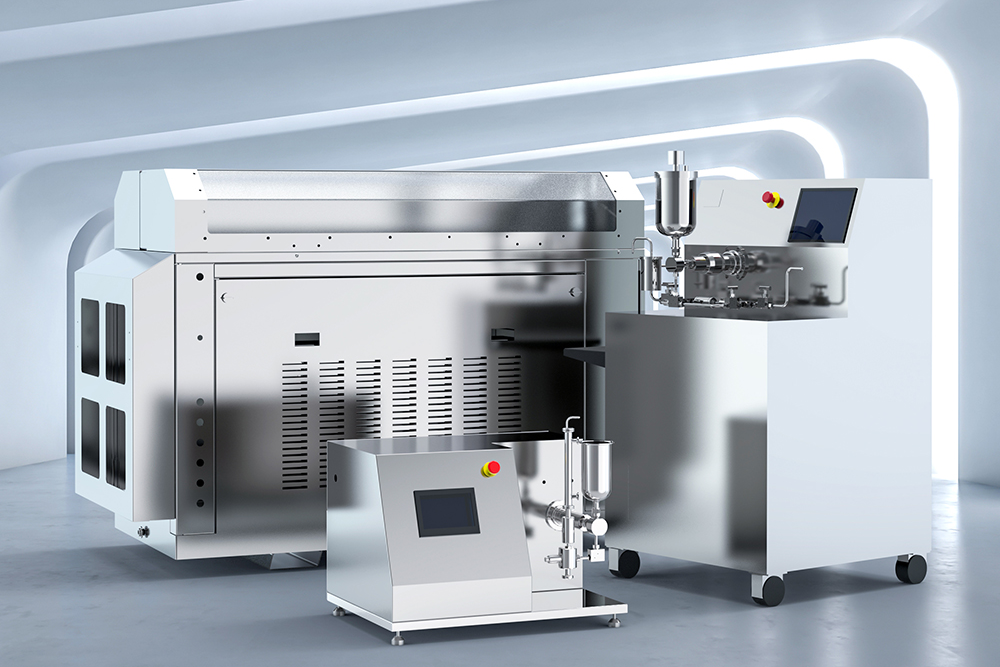
For example, the 10 L lab scale high pressure homogenizer (HPW-10) uses a servo-electric cylinder drive, requires a minimum sample volume of only 20 mL, and provides working pressures of up to 30,000 psi, making it an ideal tool for scientific research and process development.
Pilot-Scale / Production Homogenizers
Applications:
Designed to support the transition from laboratory R&D and small-batch trials to large-scale industrial production.
Typical specifications:
Processing capacities range from approximately 50 L/h to 500 L/h, with pressures of up to 1,500 bar.
For example, the pilot-scale high-pressure homogenizer (PHA Series) covers processing capacities from 60 L/h to 500 L/h. Its variable-frequency flow control system allows operators to adjust flow rates according to process requirements, making it suitable for scaling up from laboratory trials to pilot production.
For larger-scale production, the 500 L production microfluidizer homogenizer (HPW-500) provides working pressures of up to 60,000 psi, enabling efficient and stable nanoscale homogenization for industrial applications.
Conclusion: Is Homogenized Milk Good for You?
Homogenized milk is a safe and nutritious dairy product that provides the same essential nutrients as traditional milk while offering improved texture, stability, and consistency.
The advancement of high pressure homogenizer technology and microfluidic technology allows dairy manufacturers to achieve more precise control over milk structure and product performance.
As food processing continues to evolve, advanced homogenization equipment will play an increasingly important role in creating healthier, more stable, and higher-quality dairy products.
Looking to improve dairy product stability and processing efficiency?
Our advanced high pressure homogenizer and microfluidic technology solutions help food manufacturers achieve precise nano-scale dispersion and consistent product quality.