
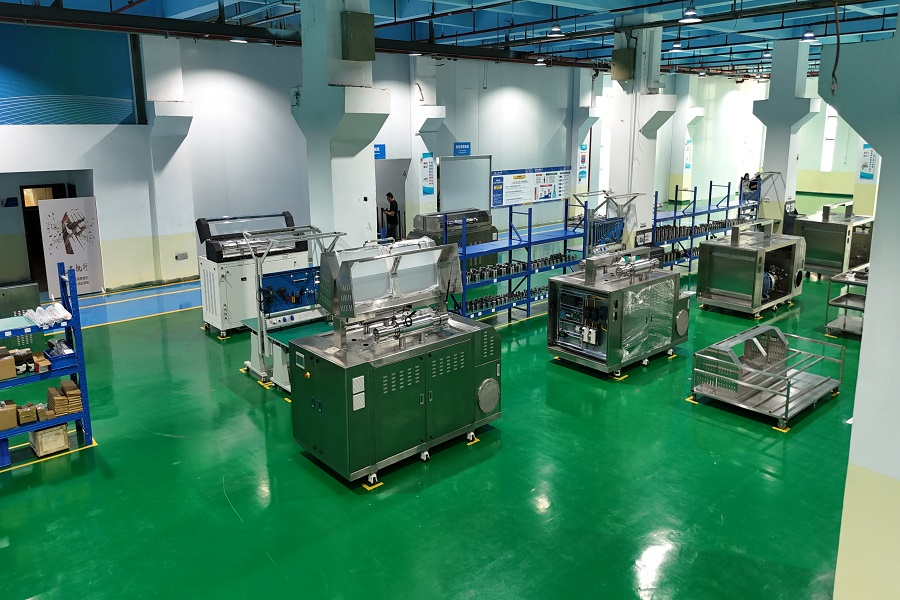
Scaling up from laboratory research to industrial production is a critical challenge for many industries, including biopharmaceuticals, food & beverage, cosmetics, and new materials. The key lies in maintaining consistent product quality, particle size, and stability throughout the process. JUNJIE’s range of high pressure homogenizers, powered by advanced microfluidics technology, offers a seamless and reliable path from lab scale high pressure homogenizer experimentation to full-scale manufacturing.
The Foundation: Lab Scale High Pressure Homogenizer for R&D
Every successful scale-up journey begins with precise and reproducible data. JUNJIE’s lab scale high pressure homogenizer is designed for this exact purpose. The HPW-10 experimental model is a compact, servo-electric driven system that provides the control needed for rigorous R&D.
- Precision & Control: With a working pressure of up to 30,000 psi (207 MPa) and a minimum sample volume of just 20ml, this lab scale high pressure homogenizer allows researchers to optimize formulations with minimal material waste.
- Core Technology: It utilizes a diamond interaction chamber, the same core technology found in our larger industrial models. This ensures that the microfluidics high pressure homogenizer effect—combining shear, collision, and cavitation—is replicated identically at every scale.
- Data Integrity: The system features a touchscreen interface for program setting, data logging, and remote monitoring, ensuring that every parameter is recorded for a seamless transfer to production.
Bridging the Gap: The Pilot-Scale Microfluidics High Pressure Homogenizer
The transition from lab to production is often the most risky step. JUNJIE’s HPW-250 pilot-scale microfluidics high pressure homogenizer is engineered to de-risk this process. It serves as a crucial bridge, validating your lab results at a larger throughput.
- Scalable Performance: With a capacity of 200-250 L/hour and a powerful 37kW hydraulic drive, the HPW-250 can handle higher viscosities and challenging materials. It replicates the high-pressure (up to 60,000 psi / 420 MPa) and diamond interaction chamber technology of the lab model, ensuring that the particle size distribution achieved in R&D is faithfully reproduced.
- Production-Ready Features: It includes a CIP/SIP (Clean-in-Place / Sterilize-in-Place) system to prevent clogging and ensure hygiene, preparing your process for the demands of continuous production. This pilot-scale high pressure homogenizer provides the critical data needed for confident industrial scaling.
Industrial Scale-Up: The Production High Pressure Homogenizer
For large-scale manufacturing, JUNJIE offers the HPW-500 production-scale high pressure homogenizer. This system is built for 24/7 continuous operation, delivering the same high-quality results as the lab and pilot models, but at an industrial volume.
- High Throughput & Reliability: With a capacity of 500 L/hour and a 75kW power unit, this high pressure homogenizer is designed for maximum efficiency. Its hydraulic drive ensures stable pressure, while the integrated CIP/SIP system minimizes downtime for cleaning.
- Consistent Quality: By using the same microfluidics high pressure homogenizer technology—the diamond interaction chamber—the HPW-500 guarantees that the nanoscale refinement and uniform dispersion achieved in the lab are maintained in every batch of mass production.
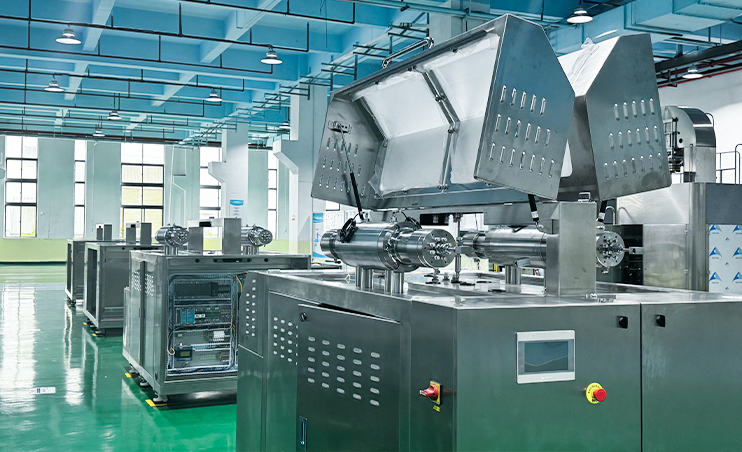
The Unifying Technology: Microfluidics High Pressure Homogenizer
The key to JUNJIE’s successful scale-up is the consistent application of microfluidics high pressure homogenizer technology across all platforms. Unlike traditional methods, the microfluidics approach forces the product stream through a fixed, diamond interaction chamber at ultra-high pressures. This creates:
- Intense Shear Forces: As the fluid reaches supersonic speeds within the microchannels.
- High-Velocity Impact: Where two opposing jets collide.
- Powerful Cavitation: From the rapid formation and collapse of micro-bubbles.
Triple Synergistic Effect: Complete Consistency from the Laboratory to Industrial Scale
These three forces do not simply add up; rather, they mutually reinforce each other and occur simultaneously at the micro- and nano-scale within the diamond interaction chamber under ultra-high pressure conditions, forming a highly efficient synergistic crushing and dispersion system. This ensures:
Extremely Narrow Particle Size Distribution: Not only can particle sizes reach the nanoscale (typically D90 < 100 nm or even smaller), but the particle size distribution curve is also extremely narrow, eliminating the presence of excessively fine or coarse particles. This is critical for the bioavailability of pharmaceuticals, the stability of food products, and the skin feel of cosmetics.
High Reproducibility Between Batches: Since the diamond interaction chamber has a fixed geometric structure with no moving parts, each batch of material undergoes exactly the same hydrodynamic path and energy input as it passes through. Consequently, from the first experimental sample processed by a lab-scale high-pressure homogenizer to the thousands of liters of product produced in industrial-scale high-pressure homogenizers, particle size and uniformity can be reproduced with an extremely high degree of consistency across batches.
Suitable for a Wide Range of Material Systems: Whether dealing with shear-sensitive proteins or liposomes, high-viscosity polymer solutions or suspensions, or heat-sensitive materials requiring strict temperature control (JUNJIE homogenizers can be equipped with an optional heat exchange system), the triple-action mechanism can be precisely tailored by adjusting pressure, flow rate, and interaction chamber type to achieve optimal processing results.
Conclusion
JUNJIE offers a comprehensive, integrated solution to scale up your process. By utilizing the same core microfluidic high-pressure homogenization technology across the entire range—from laboratory-scale high-pressure homogenizers to industrial-grade production models—we ensure that every optimized parameter obtained by researchers during early R&D can be precisely replicated in large-scale industrial production. This completely eliminates scaling-up risks, making the commercialization of nanoparticle products more efficient and reliable. You can eliminate uncertainties and risks during the scale-up process. This ensures that the quality, stability, and performance of your products remain consistent from the very first test tube to the final production batch, thereby accelerating your time to market and ensuring commercial success.