

The rapid development of advanced materials, new energy technologies, biotechnology, and high-performance chemical products has created increasingly demanding requirements for material processing. Traditional mixing, emulsification, and dispersion methods often struggle to achieve uniform particle distribution, long-term stability, and consistent product performance at the nanoscale level.
In this context, high pressure microfluidic technology has emerged as a revolutionary processing approach, enabling precise control of particle size, molecular interaction, and material structure. Among these innovations, the high pressure microfluidic homogenizer has become a critical platform for researchers and manufacturers seeking to develop next-generation materials with enhanced functionality.
By utilizing ultra-high-pressure forces, controlled microchannels, shear stress, cavitation, and impact effects, microfluidic homogenization technology can efficiently break down particles and droplets into nano-scale structures. This capability is transforming the way new materials are designed, processed, and commercialized across multiple industries.
Why Advanced Microfluidic Homogenizer Systems Matter for Material Innovation
The development of new materials requires more than advanced formulas—it requires advanced processing technologies capable of precisely controlling material structures.
A professional high pressure microfluidic homogenizer provides researchers and manufacturers with:
- Nano-scale dispersion capability
- Stable and repeatable processing performance
- Flexible application possibilities
- Industrial-scale production support
From new energy materials and nanotechnology to biopharmaceuticals and advanced chemical applications, microfluidic technology is becoming a key driver of industrial transformation.
Breaking Through Traditional Dispersion Process Bottlenecks
Traditional material dispersion processes (such as ball milling and sand milling) suffer from issues such as wide particle size distribution, poor batch consistency, and susceptibility to metal contamination. The JUNJIE Microfluidic Homogenizer overcomes these challenges through the following technical innovations:
| Technical Dimension | Traditional Process Pain Points | JUNJIE Microfluidic Solution |
|---|---|---|
| Homogenization Principle | Relies on grinding media, prone to wear and contamination | Grinding-media-free design, synergistic action of pure physical impingement + cavitation effect + shear force |
| Particle Size Control | Wide distribution, difficult to precisely control | Diamond interaction chamber with fixed internal micro-channels, ensuring uniform and stable particle size across batches |
| Pressure Range | Conventional equipment insufficient pressure (200-207MPa) | Design pressure up to 420MPa (60,000 psi), capable of processing hard agglomerated materials |
Typical Applications: Efficient dispersion and pure physical exfoliation of graphene, carbon nanotube dispersion, boron nitride, nanocellulose, and other new materials, avoiding chemical contamination while preserving the original material structure integrity.
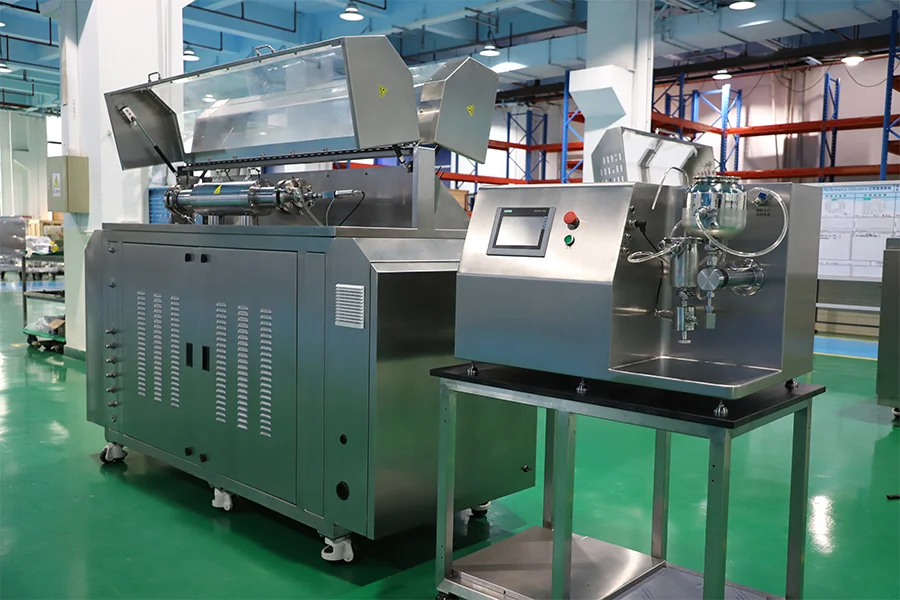
Enabling Full-Chain Process Scale-Up from Laboratory to Mass Production
One of the biggest challenges in new materials R&D is the difficulty of scaling up laboratory results to commercial production. JUNJIE provides a full product line covering all stages:
| Product Model | Positioning | Processing Capacity | Design Pressure | Key Features |
| HPW-10 | LLab Scale | 10L/batch | 420MPa | Servo direct drive, minimum sample volume 20ml, suitable for small-batch R&D |
| HPW-250 | Pilot Scale | 250L/batch | 420MPa | Hydraulic drive, 37kW, bridging lab and production |
| HPW-500 | Production Scale | 500L/batch | 420MPa | 75kW, supports 24-hour continuous production, CIP/SIP online cleaning |
Core Advantage: All models share a unified design pressure of 420MPa, enabling linear scale-up of process parameters. Parameters validated during R&D can be directly transferred to pilot and production equipment, eliminating the need to re-optimize parameters, significantly shortening the cycle from R&D to mass production.
Redefining the Application Boundaries and Performance Limits of New Materials
The specific transformations brought by JUNJIE equipment in the new materials field include:
1. Graphene and 2D Materials
- Efficient Exfoliation: Synergistic cavitation and shear forces achieve physical exfoliation, free from chemical contamination
- Scalable Production: Full coverage from gram-level R&D to kilogram-level mass production, supporting commercial deployment
2. Nano Functional Materials
- Customized Processes: In-depth analysis of material characteristics (viscosity/particle size/interfacial energy) for graphene, nano-ceramics, metal pastes, etc., tailoring “homogenization-dispersion-stabilization” full-chain processes
- 7-day delivery of exclusive solutions, supporting seamless scale-up from lab → pilot → production
3. New Energy Materials
- Electrode Slurries: Optimizing nano-level uniform dispersion of solid-state electrolytes, silicon-carbon anodes, and carbon nanotube conductive pastes
- Preserving Material Structure Integrity: High shear force uniformly breaks agglomerates without damaging the material’s microstructure
4. Semiconductor and Electronic Materials
- Metal-Free Contamination: Ultra-low wear from all-diamond chamber, meeting stringent purity requirements for CMP polishing slurries and MLCC barium titanate pastes
- High Batch Consistency: Stable pressure output ensures consistent particle size distribution across every batch
Building a “Process Accompaniment” Service System
JUNJIE provides a full-cycle service through its Microfluidic Nano Homogenization Materials Laboratory, accelerating the commercialization of new materials:
| Service Stage | Service Content | Significance for the New Materials Industry |
|---|---|---|
| Pre-Sales | Free sample testing, providing particle size distribution reports and process recommendations | Customers can validate process feasibility without purchasing equipment |
| Process Development | Joint process development, full support from parameter screening to pilot validation | Reducing trial-and-error costs in new materials R&D |
| Scale-Up Validation | Data alignment from lab → pilot → production models | Ensuring process reproducibility, reducing scale-up risks |
| After-Sales | Preventive maintenance, spare parts support, equipment upgrades and retrofits | Ensuring stable |
Microfluidic Technology Creating the Future of New Materials
The impact of microfluidic homogenization technology on the new materials industry is profound. By enabling precise nano-scale processing, improving dispersion quality, and enhancing material performance, the high pressure microfluidic homogenizer is accelerating innovation across multiple industries.
As demand grows for higher-performance materials, cleaner manufacturing processes, and smarter production systems, microfluidic application will continue expanding into emerging fields and becoming an essential technology for future material development.
With advanced engineering capabilities, independent core component manufacturing, and integrated processing solutions, next-generation microfluidic homogenizer systems will play a critical role in shaping the future of advanced materials.