
The chemical industry is rapidly evolving toward higher-performance materials, finer particle distributions, and more efficient manufacturing processes. Whether producing nanomaterials, advanced coatings, battery materials, catalysts, pigments, or specialty chemicals, manufacturers are under constant pressure to improve product quality while maintaining production efficiency.
Traditional mixing and milling technologies often struggle to deliver the nanoscale particle sizes and uniform dispersion required by today’s advanced chemical formulations. This is where the high pressure homogenizer, powered by advanced microfluidic technology, becomes a critical processing solution.
A microfluidic high pressure homogenizer utilizes ultra-high pressure combined with precisely engineered interaction chambers to generate intense shear forces, impact, turbulence, and cavitation. These physical effects efficiently reduce particle size, improve dispersion uniformity, and significantly enhance product stability without altering chemical composition.
As an experienced high pressure homogenizer manufacturer, we provide complete nano-processing solutions for research laboratories, pilot-scale development, and industrial production across a wide range of chemical applications.
Core Pain Points in Chemical Industry Fine Processing
| Pain Point | Limitations of Traditional Equipment |
|---|---|
| Wide particle size distribution | Conventional homogenizers (high-shear, ball milling) struggle to achieve narrow distribution, typically PDI > 0.3 |
| Difficulty in nanoscale dispersion | Fillers such as carbon nanotubes, graphene, and nano-ceramics are prone to agglomeration; traditional equipment cannot effectively de-agglomerate |
| Difficulty processing high-viscosity materials | High-viscosity systems such as adhesives and polymer resins have low homogenization efficiency and high risk of clogging |
| Poor batch repeatability | Adjustable gap design in valve-type homogenizers causes pressure fluctuations and batch-to-batch variation |
| Risk of metal contamination | Wear of dynamic seals generates metal particles, affecting purity of high-end chemicals |
| Difficulty in process scale-up | Lab parameters cannot be directly scaled to production, requiring extensive repea· |
To address common challenges in fine chemical processing—including broad particle size distribution, difficulty achieving nanoscale dispersion, processing high-viscosity materials, poor batch-to-batch consistency, risk of metal contamination, and challenges in process scale-up—the Microfluidizer provides an ideal solution.
Powered by a fixed-geometry diamond interaction chamber, the system operates at ultra-high pressures of up to 420 MPa, where high shear, jet-to-jet impact, and cavitation work synergistically to achieve precise nanoscale particle size reduction and uniform dispersion. The process can produce particle size distributions with a PDI below 0.12.
Its seal-free interaction chamber design eliminates the risk of metal contamination at the source, while the fixed microchannel geometry ensures highly reproducible particle size and distribution across production batches. In addition, process parameters developed at the laboratory scale can be directly transferred to pilot and commercial production, enabling seamless scale-up without compromising product quality.
As a result, the Microfluidizer effectively overcomes the limitations of conventional homogenization technologies, delivering consistent product quality, higher process efficiency, and reliable industrial-scale manufacturing for advanced chemical applications.
Working Principle of the Microfluidizer
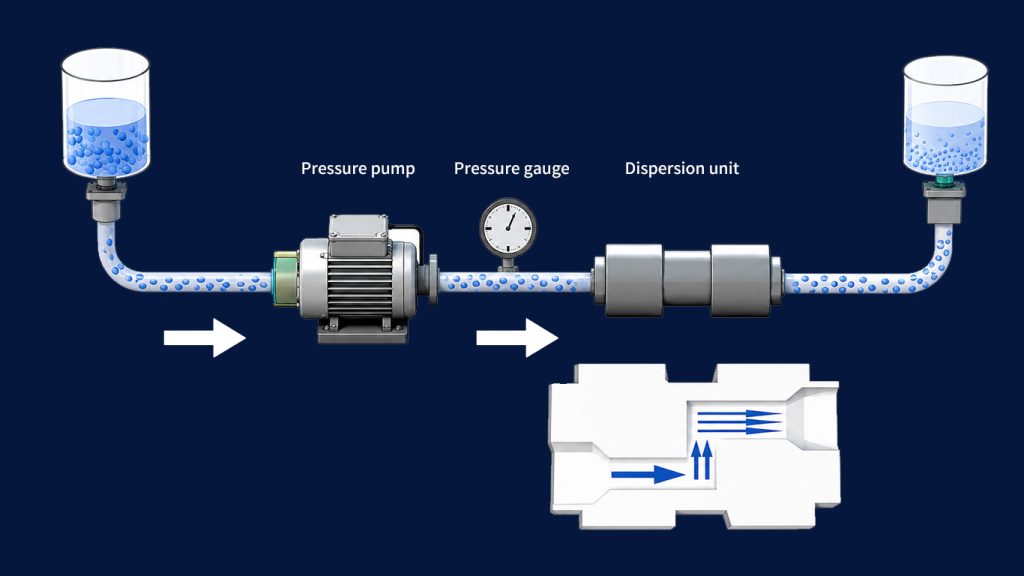
A Microfluidizer uses ultra-high pressure (up to 420 MPa) to pressurize the material and force it at high velocity through precision-engineered diamond interaction chamber microchannels. Inside the chamber, the material forms supersonic microjets, where three powerful forces work together to achieve nanoscale particle size reduction:
- High Shear Force: High-speed flow generates intense shear that breaks down particles and droplets.
- Jet-to-Jet Impact: Multiple microjets collide within a fixed-geometry interaction chamber, producing tremendous impact energy.
- Cavitation Effect: The rapid formation and collapse of microscopic bubbles generate powerful shock waves that further reduce particle size.
Unlike conventional mixing and rotor-stator homogenization, a Microfluidizer delivers precise particle size reduction, highly uniform dispersion, and excellent batch-to-batch consistency.
Technical Applications of Microfluidizers in the Chemical Industry
Nanomaterial Synthesis and Dispersion
Using ultra-high-pressure microfluidization technology, a Microfluidizer can efficiently reduce solid particles or liquid droplets to the nanoscale, making it widely used in the production of nanoparticles, nanoemulsions, and nanocomposite materials.
Key Benefits
- Precisely controls particle size and distribution by adjusting operating pressure and processing cycles.
- Improves material performance for high-performance catalysts, optoelectronic materials, and functional electronic components.
- Enables consistent production of high-quality nanomaterials.
Typical Applications
- Metal nanoparticles
- Metal oxide nanoparticles
- Quantum dots
Homogenization and Viscosity Reduction of High-Viscosity Fluids
For high-viscosity materials such as lubricants, adhesives, and polymer resins, a Microfluidizer effectively disrupts gel structures and molecular aggregates.
Key Benefits
- Simultaneously homogenizes materials while reducing system viscosity.
- Improves flowability and product consistency.
- Facilitates downstream processes such as pumping, spraying, and coating.
Typical Applications
- Lubricant additive dispersion
- Adhesive homogenization
- Polymer resin viscosity reduction
Organic Synthesis and Emulsion Polymerization
In fine chemical synthesis and emulsion polymerization, a Microfluidizer enables rapid and uniform molecular-level mixing of all reaction components.
Key Benefits
- Significantly increases reaction rates and conversion efficiency through improved reactant contact.
- Produces highly uniform and stable microemulsions.
- Supports the production of high-performance polymers and specialty chemicals.
Typical Applications
- Fine chemical synthesis
- Emulsion polymerization
- Microemulsion preparation
High-Precision Homogenization of Electronic Slurries and Conductive Inks
Microfluidizers are widely used to homogenize electronic slurries, conductive inks, and other advanced electronic materials.
Key Benefits
- Ensures highly uniform distribution of functional particles.
- Improves printability, electrical conductivity, and final product reliability.
- Delivers excellent dispersion performance for high-solid-content and high-viscosity formulations.
Typical Applications
- Conductive silver paste
- MLCC ceramic slurry
- Conductive inks
- Electronic packaging materials
Structural Control of Composite Materials
In the production of nanocomposites, a Microfluidizer efficiently and uniformly disperses nanofillers—such as carbon nanotubes, graphene, and nanoceramics—into polymer or metal matrices.
Key Benefits
- Prevents nanoparticle agglomeration and improves interfacial bonding.
- Enhances the electrical, thermal, and mechanical properties of composite materials.
- Produces more stable and higher-performance composite structures.
Typical Applications
- Nanoceramic composites
- Carbon nanotube/polymer composites
- Graphene-reinforced materials
Application Advantages: Addressing Chemical Industry Needs
| Industry Need | Microfluidizer Solution |
|---|---|
| Uniform dispersion, improved material performance | Nanoscale ultra-fine particle dispersion, breaking through limitations of traditional dispersion technology |
| Viscous material property adjustment | Effectively reduces viscosity of high-viscosity fluids, improving processing performance |
| Shortened process flow and production time | Achieves target particle size in a single pass, reducing number of cycles |
| Meeting compliance requirements for high-end chemicals | Optional GMP/GLP recording system, supporting data traceability |
| Reduced R&D waste of valuable raw materials | Minimum sample volume as low as 20ml, residual volume approximately 1ml |
| High batch-to-batch consistency | Fixed-geometry channel design ensures repeatability of process parameters |
JUNJIE Microfluidizer: A Full-Process Solution for the Chemical Industry
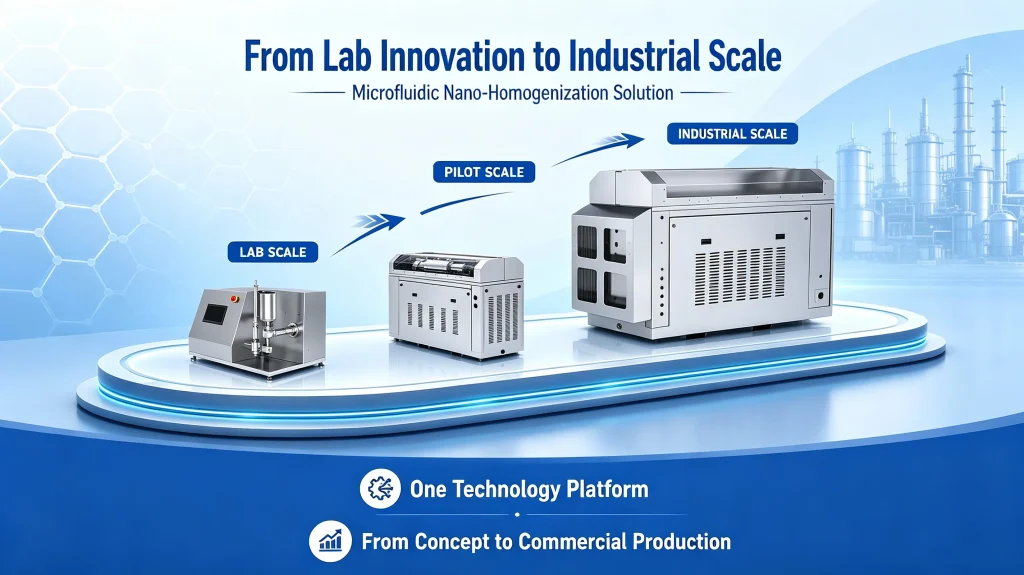
JUNJIE’s microfluidizer product line covers the complete process from laboratory R&D to industrial-scale production, meeting the needs of the chemical industry at different stages:
| Model | Type | Capacity | Max Pressure | Application Scenario |
|---|---|---|---|---|
| HPW-10 | Lab-scale | 8-10 L | 30,000 psi (≈207 MPa) | Lab R&D, small-scale process validation |
| HPW-250 | Pilot-scale | 200-250 L | 60,000 psi (≈420 MPa) | Pilot scale-up, small-batch production |
| HPW-500 | Production-scale | 500 L | 60,000 psi (≈420 MPa) | Large-scale industrial production |
| HPW-X | Custom | Customized | Customized | Special scenarios, special material requirements |
Conclusion
The chemical industry is moving toward increasingly sophisticated materials that require exceptional precision in particle size control, dispersion quality, and product stability. A microfluidic high pressure homogenizer offers an efficient and scalable solution for achieving these goals through advanced microfluidic technology.
Whether producing nanomaterials, battery slurries, specialty chemicals, pigments, or polymer emulsions, a high-performance high pressure homogenizer delivers consistent nano-scale processing with outstanding repeatability.
Partnering with a trusted high pressure homogenizer manufacturer ensures not only reliable equipment but also expert process support, customized solutions, and long-term production success. As industries continue to pursue higher performance and greater efficiency, microfluidic homogenization is becoming an indispensable technology for the future of chemical manufacturing.