
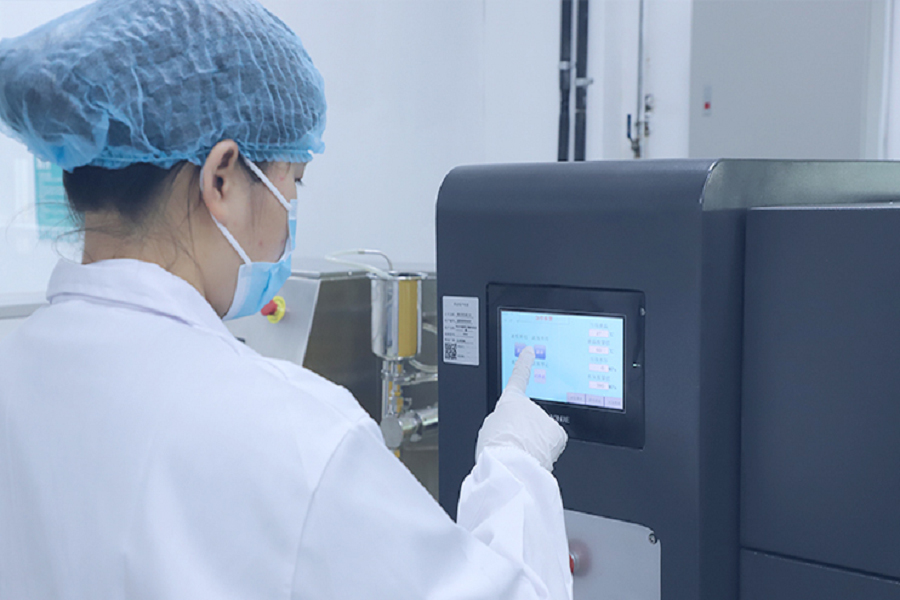
Ultra-High-Pressure Microjet Homogenizers have become essential equipment in industries requiring extremely fine particle size reduction, high emulsion stability, and uniform product quality. From pharmaceuticals and biotechnology to food processing, cosmetics, and nanomaterials, this advanced homogenization technology delivers superior performance compared to conventional high-pressure homogenizers.
But how exactly does an Ultra-High-Pressure Microjet Homogenizer work? This article explains its operating principle, key components, processing advantages, and industrial applications.
What Is an Ultra High Pressure Homogenizer?
An Ultra-High-Pressure Microjet Homogenizer is a precision processing system that forces liquid materials through specially designed microchannels under ultra-high pressure, typically ranging from 100 MPa to 400 MPa (up to 60,000 psi in some models).
Unlike traditional homogenizers that rely primarily on mechanical valve impact, microjet homogenizers utilize controlled fluid dynamics to generate multiple powerful forces that break particles and droplets into nano-sized structures.
The result is highly stable emulsions, suspensions, liposomes, nano-dispersions, and cell disruption with exceptional repeatability.
Working Principle of JUNJIE’s Ultra High Pressure Homogenizer
Core Principle
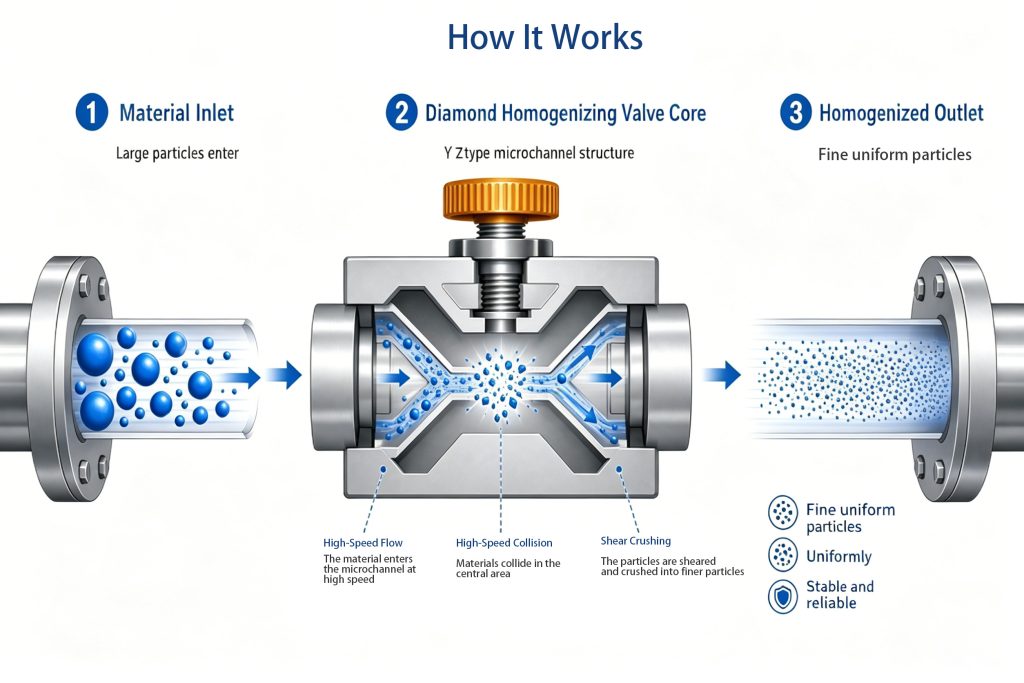
The ultra-high pressure microjet homogenizer uses ultra-high pressure (up to 420MPa) as its core driving force. Its working principle is completely different from traditional stirring and shearing equipment, achieving nano-scale refinement and uniform dispersion of materials through the following steps:
Step 1: Material Pressurization and Acceleration
The material is pressurized to an ultra-high pressure state (up to 420MPa) driven by a high-pressure pump, forming a strong kinetic energy reserve.
Step 2: Supersonic Jet
The pressurized material is pushed at extremely high speed into a specially designed diamond interaction chamber with micro-channels. The material forms a supersonic jet inside the channel.
Step 3: Triple Physical Force Synergy
Inside the diamond interaction chamber with its fixed geometric micro-channel structure, three powerful physical forces are simultaneously generated, working in synergy to complete homogenization:
- Strong Shear Force — The high-speed flow of material within the micro-channels generates a powerful shearing effect, shearing and breaking down particles
- Frontal Jet Collision Force — Multiple material streams collide at high speed at a precisely designed impingement point, instantly converting enormous kinetic energy into crushing force
- Cavitation Effect (Impact Force from Instantaneous Bubble Generation and Collapse) — A large number of tiny bubbles generated under high pressure instantly form and collapse, producing powerful shock waves
Step 4: Nano-Scale Refinement and Dispersion
Under the synergistic action of the three forces above, material particles are efficiently refined to the nano-scale and dispersed with extreme uniformity, achieving results far superior to traditional equipment.
Core Working Unit: Diamond Interaction Chamber
The core homogenization unit of JUNJIE equipment is the Diamond Interaction Chamber (optional Y-type or Z-type), which features a fixed micro-channel structure internally, ensuring stable and uniform particle size results across batches.
- Y-type Chamber: Primarily achieves crushing through collision, suitable for processing soft particles such as emulsions and liposomes
- Z-type Chamber: Achieves crushing through multi-angle shear + collision, suitable for hard particle processing such as cell disruption and graphene exfoliation
Application Field Adaptability
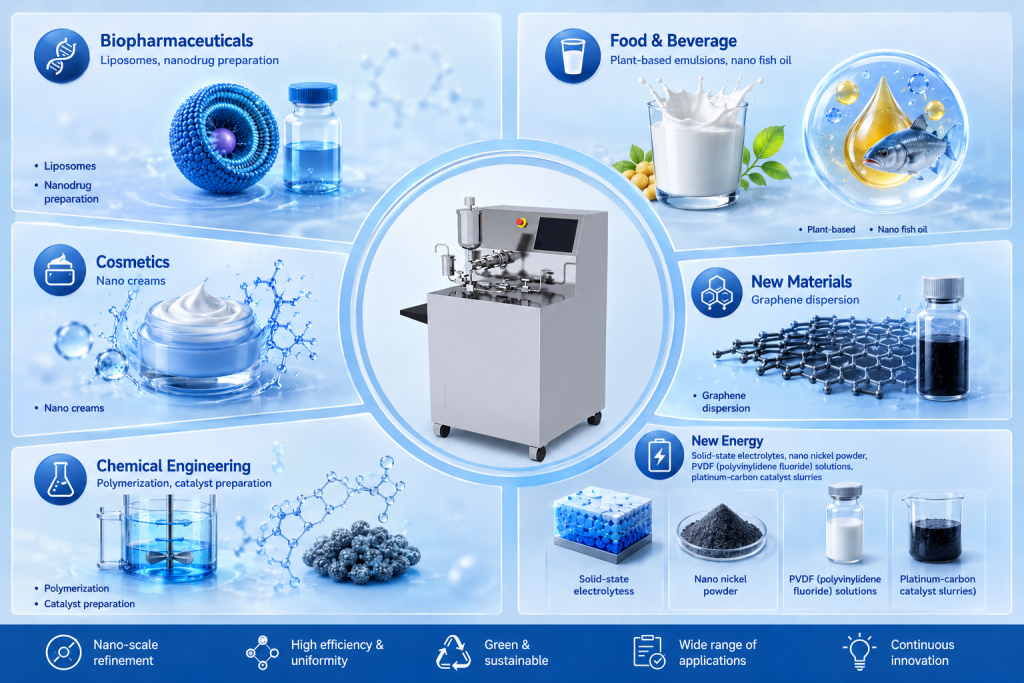
This working principle enables the equipment to efficiently adapt to a variety of challenging materials, including:
- Biopharmaceuticals — Liposomes, nanodrug preparation
- Food & Beverage — Plant-based emulsions, nano fish oil
- Cosmetics — Nano creams
- New Materials — Graphene dispersion
- Chemical Engineering — Polymerization, catalyst preparation
- New Energy — Solid-state electrolytes, nano nickel powder, PVDF (polyvinylidene fluoride) solutions, platinum-carbon catalyst slurries
Ultimately achieving a core homogenization solution characterized by “precise refinement, uniform dispersion, and consistent inter-batch stability”.
Advantages of Ultra High Pressure Homogenizer
Compared with conventional homogenizers, Ultra-High-Pressure Microjet Homogenizers offer several significant advantages.
Extremely Small Particle Size
Nano-scale particle sizes improve product stability, bioavailability, appearance, and functionality.
Narrow Particle Size Distribution
Uniform particle distribution enhances consistency and product performance.
Excellent Repeatability
Precisely engineered interaction chambers ensure highly reproducible processing results.
Minimal Contamination
Since processing relies on fluid interaction rather than mechanical grinding, equipment wear is significantly reduced.
Broad Material Compatibility
Suitable for low-, medium-, and high-viscosity fluids across numerous industries.
Why Choose Ultra-High-Pressure Microfluidic Technology?
Compared with traditional high-pressure homogenization, microjet technology provides:
- Higher energy efficiency
- Better particle size control
- Improved product stability
- Lower batch-to-batch variation
- Better scalability from laboratory to industrial production
These advantages make it the preferred solution for manufacturers pursuing high-value products and precision processing.
Conclusion
The Ultra-High-Pressure Microjet Homogenizer operates by converting ultra-high pressure into controlled kinetic energy within specially designed microchannels. Through the combined effects of shear, cavitation, turbulence, and high-speed impact, it produces exceptionally fine and uniform particle dispersions.
As industries increasingly demand nano-scale materials, higher product quality, and improved processing efficiency, Ultra-High-Pressure Microjet Homogenizers continue to play a vital role in pharmaceutical manufacturing, food processing, biotechnology, cosmetics, and advanced material production.
For companies seeking superior homogenization performance and scalable production, investing in Ultra-High-Pressure Microjet technology offers a reliable path toward higher product quality and greater manufacturing efficiency.